Instrument comparison · F4 Household
Paper questionnaire ↔ CAPI (CSEntry tablet)
Each section of the printed Household (F4) questionnaire beside its CSEntry tablet screens — including the household roster and expenditure grids.
The real printed pages
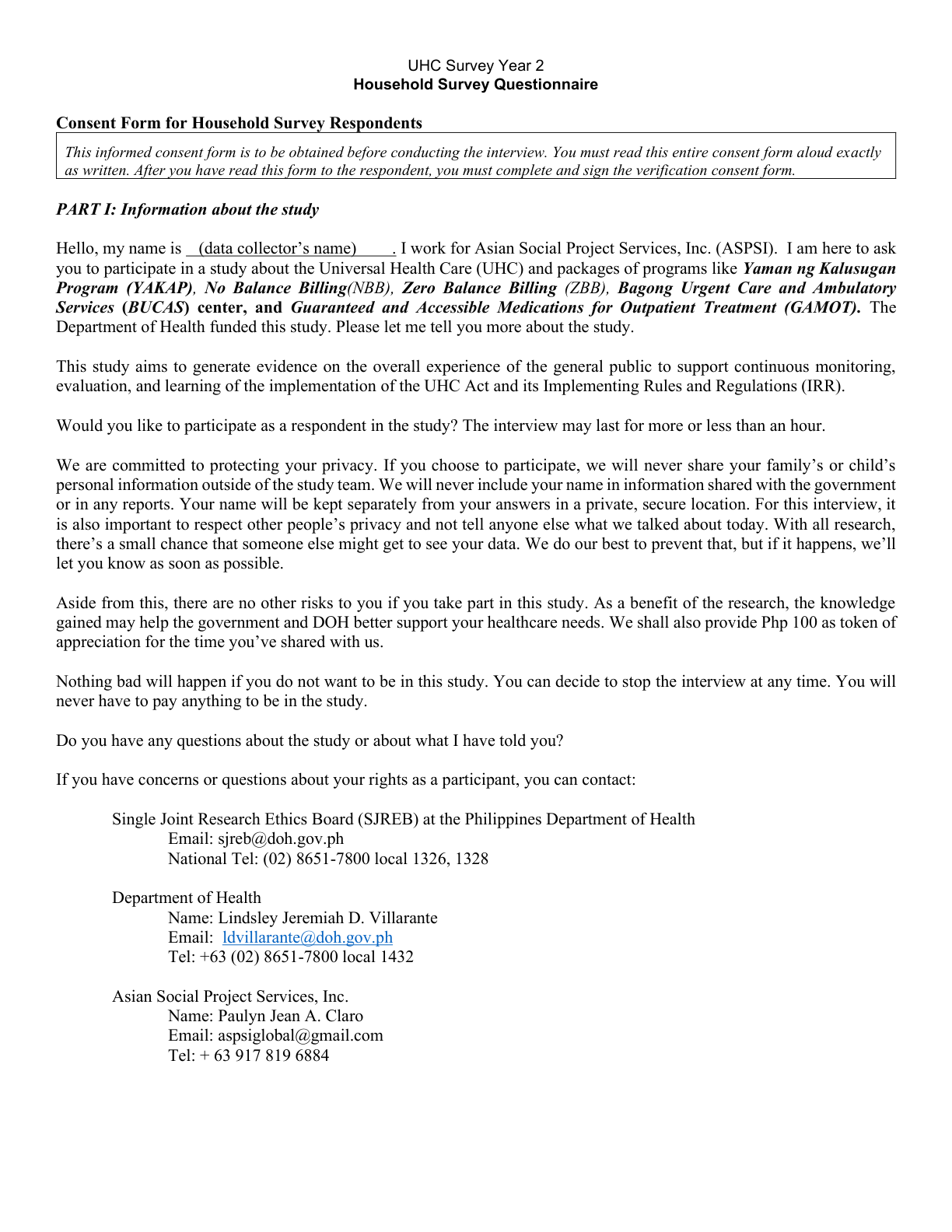
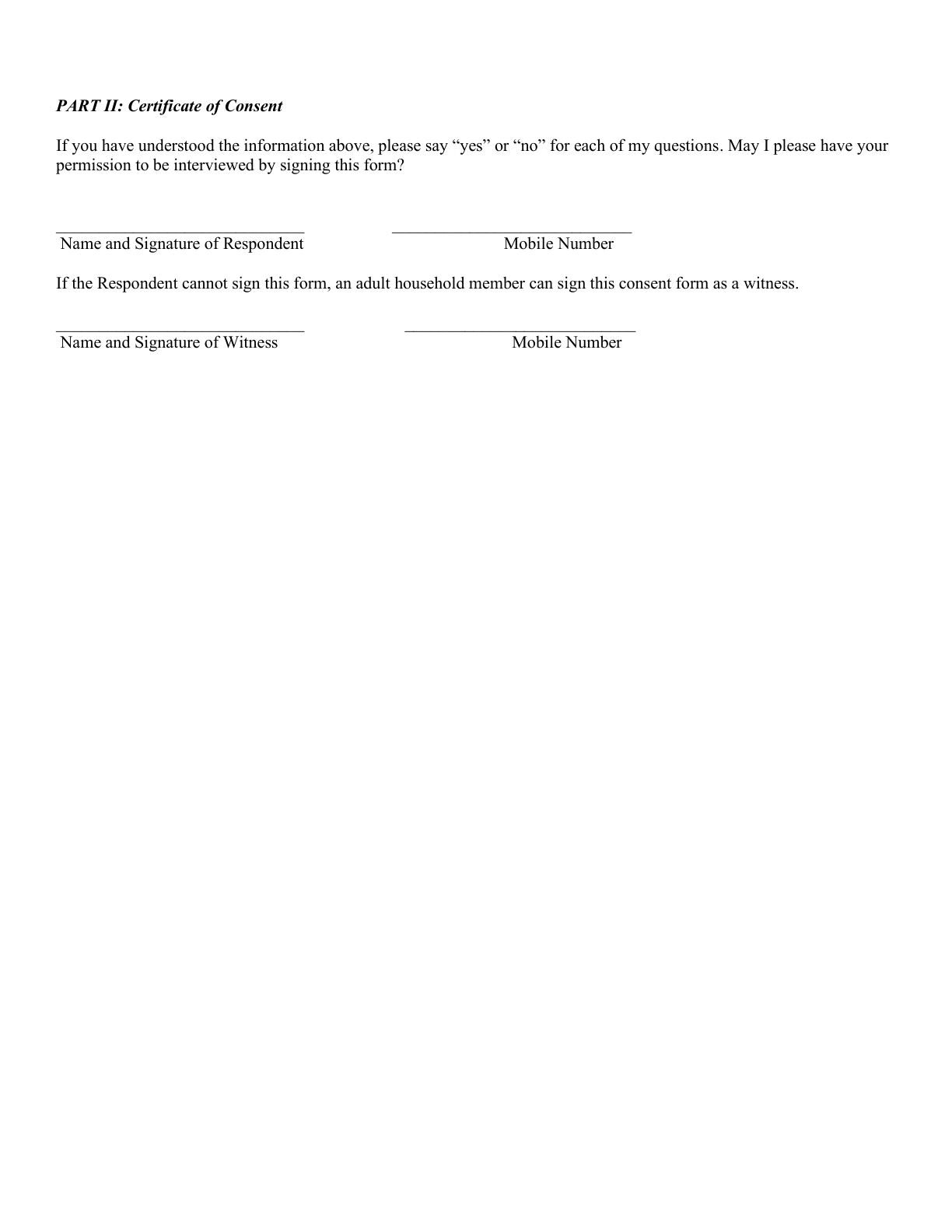
Pages 1–2 — the consent script and certificate of consent.
CSEntry (tablet)
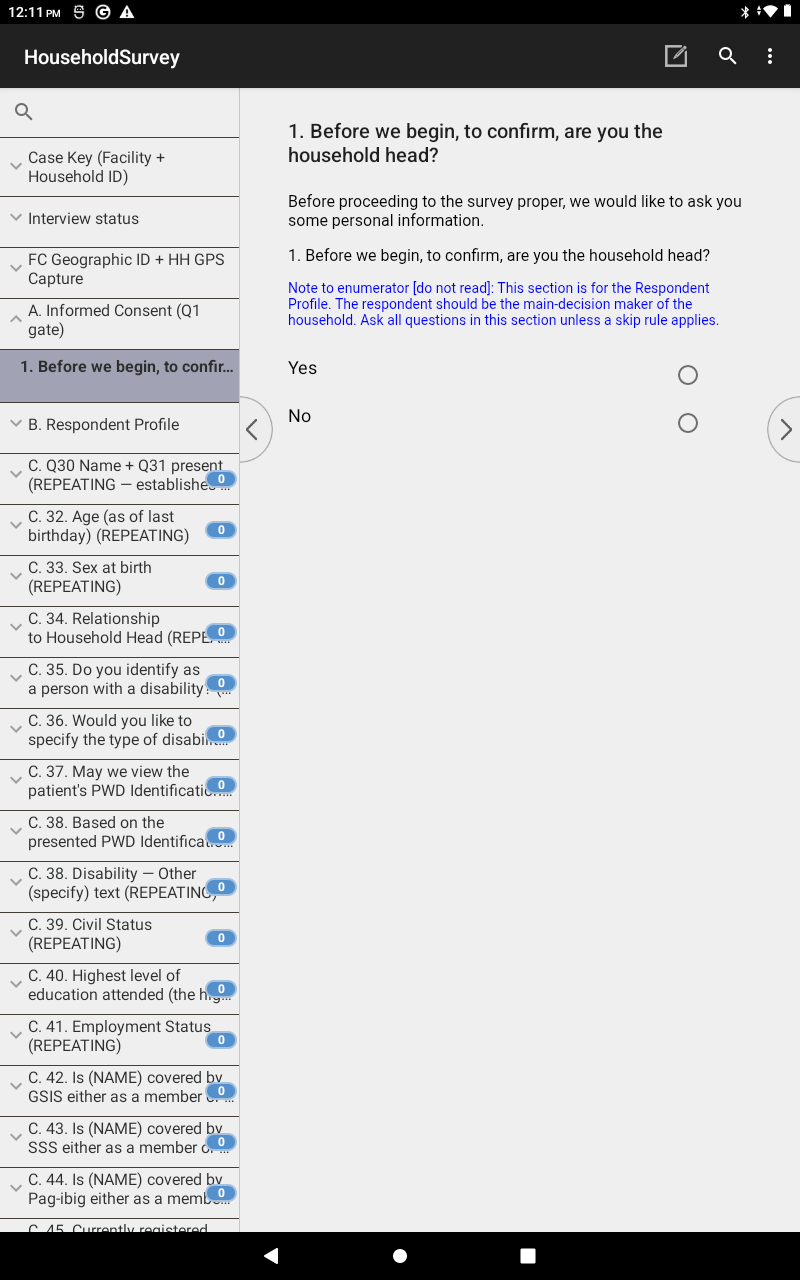
Consent is recorded on screen as a Yes / No (shown) and gates the rest of the interview — a “No” ends it. The script text is read from the device, not free-typed.
On paper
1. Before we begin, to confirm, are you the household head?
- Q1: Yes · No
On the tablet (CAPI)
Yes/No single-select radio. This is the consent/eligibility gate for the form — interviewer confirms the respondent is the household head before continuing into Section B.
The real printed pages
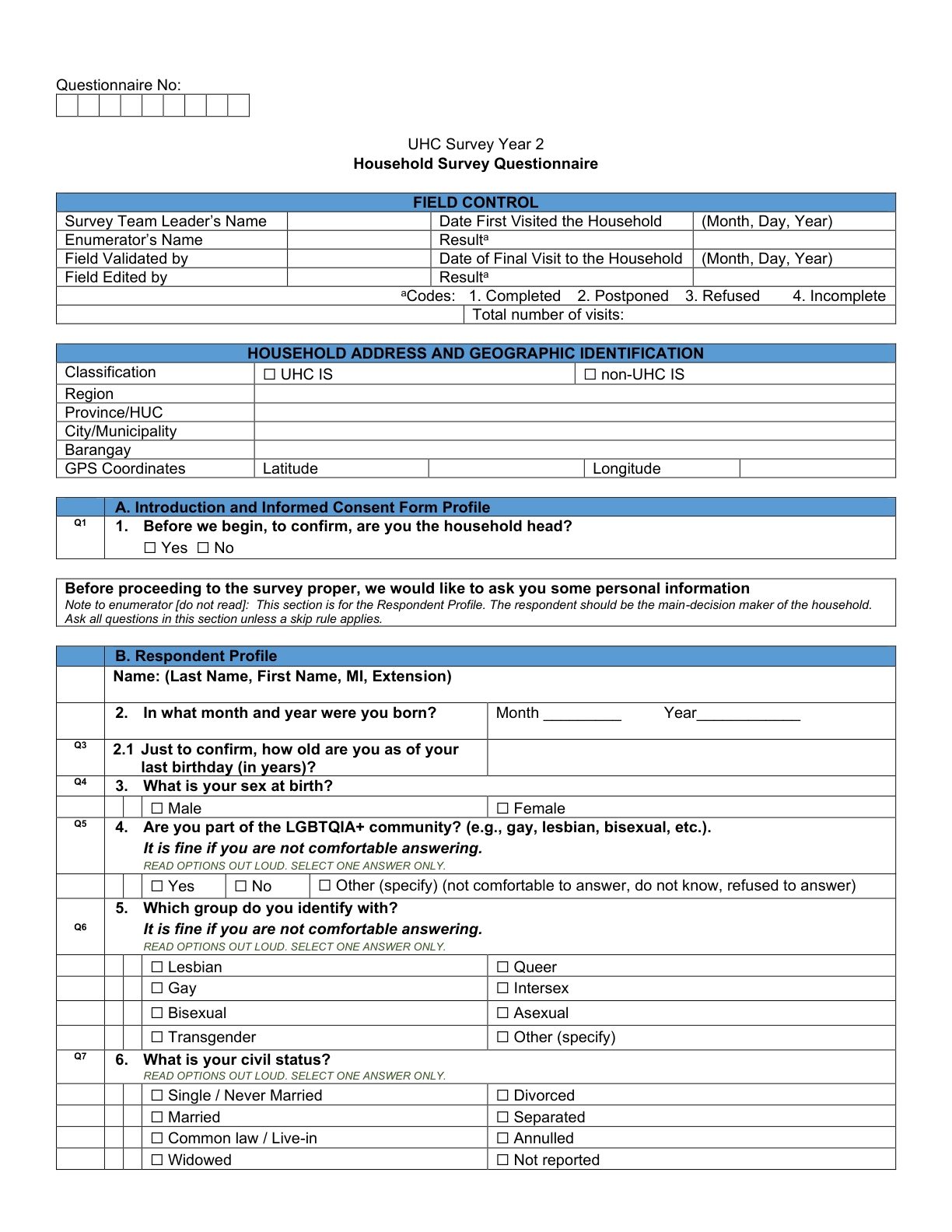
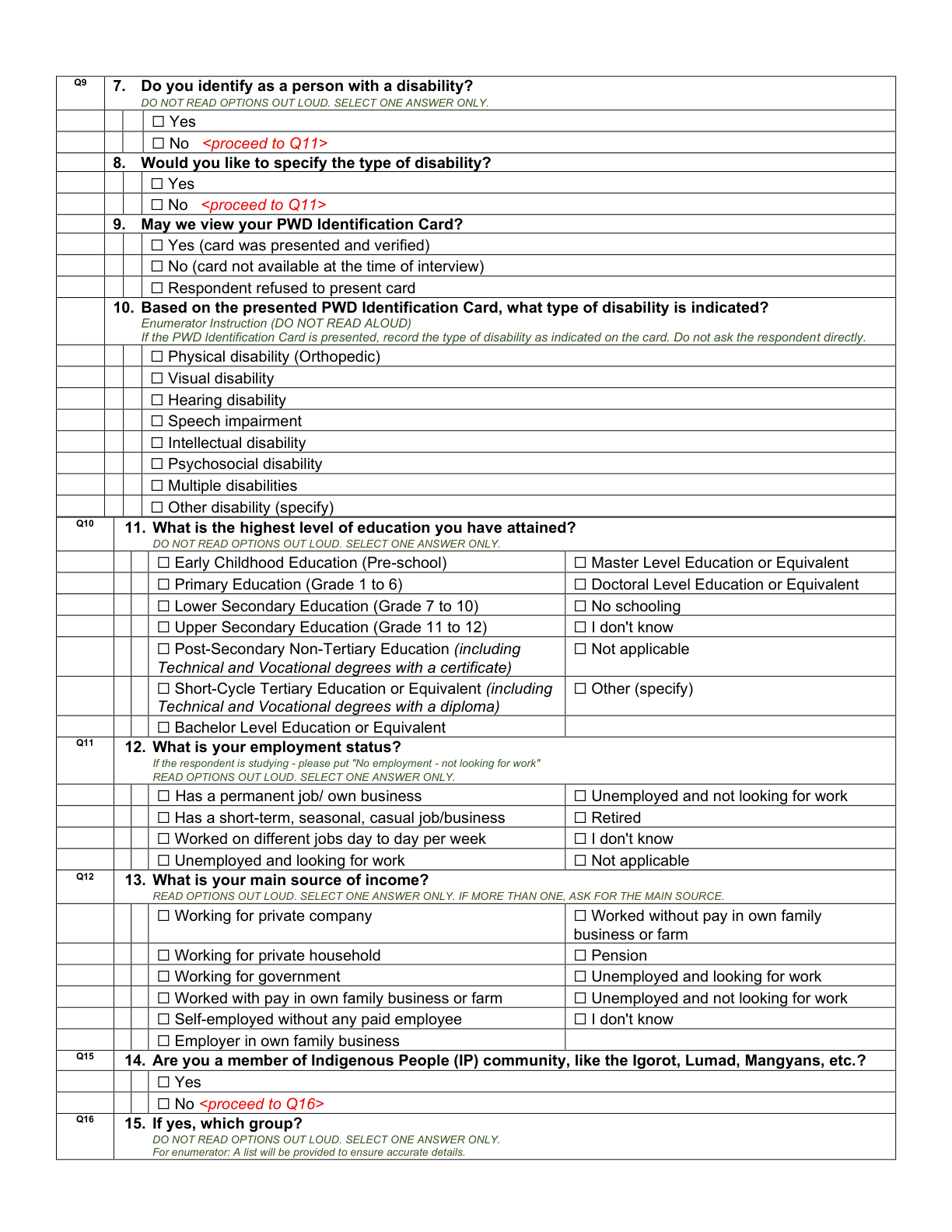
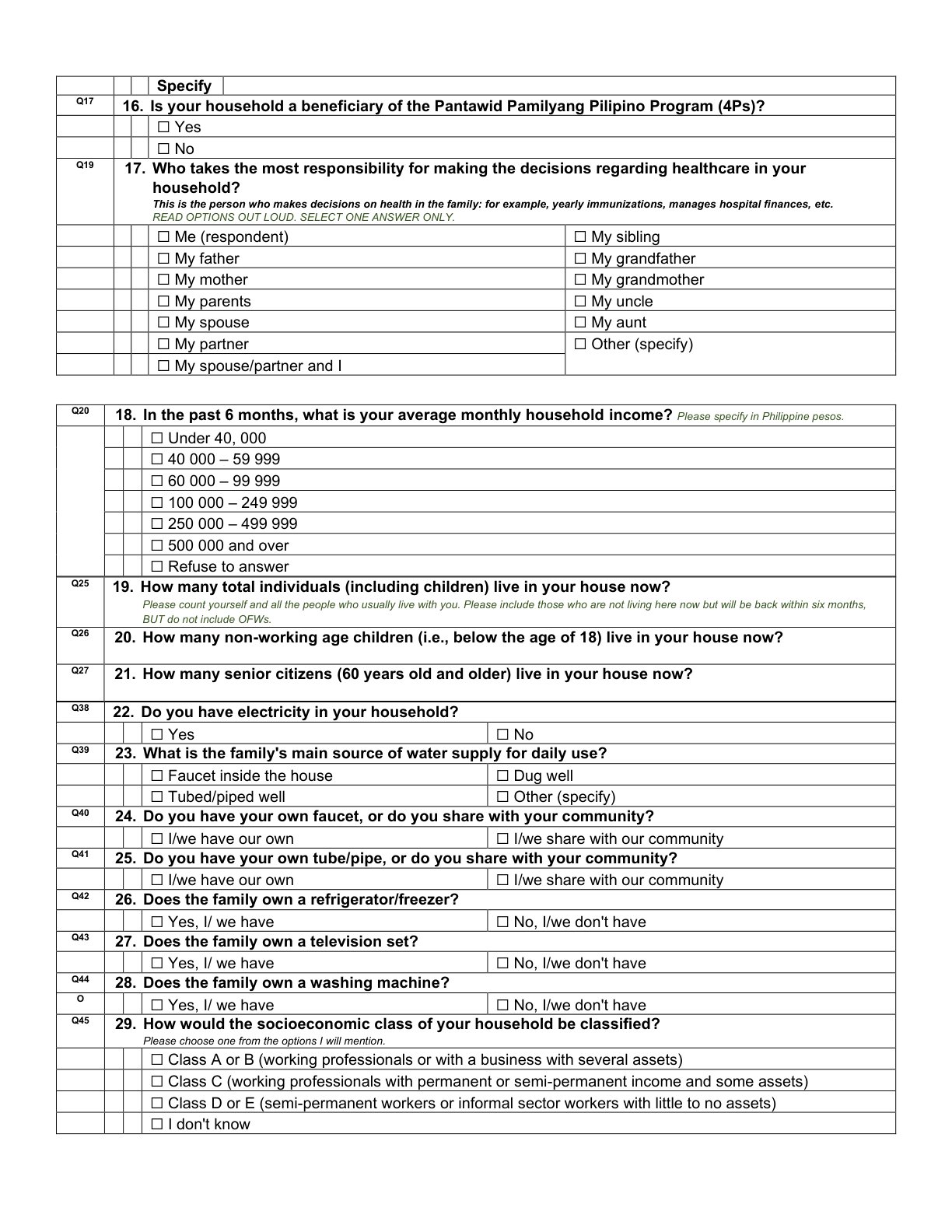
Pages 3–5 — Introduction/Consent (A) and Respondent Profile (B). Tap to open full size.
CSEntry (tablet)
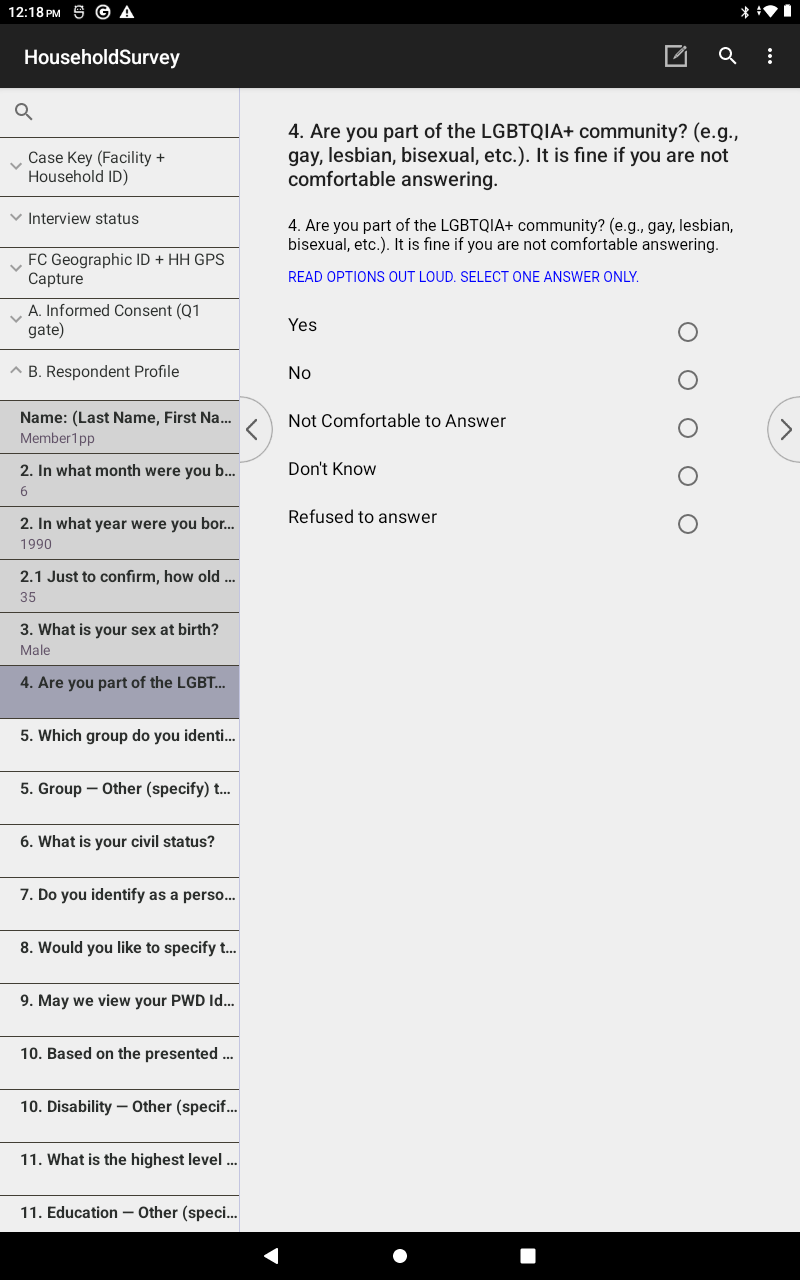
A single Yes/No tap confirms the household head before the profile questions open.
On paper
Name: (Last Name, First Name, MI, Extension) · 2. In what month were you born? · 2. In what year were you born? · 2.1 Just to confirm, how old are you as of your last birthday (in years)?
- Name: free text · Month/Year/Age: numeric
On the tablet (CAPI)
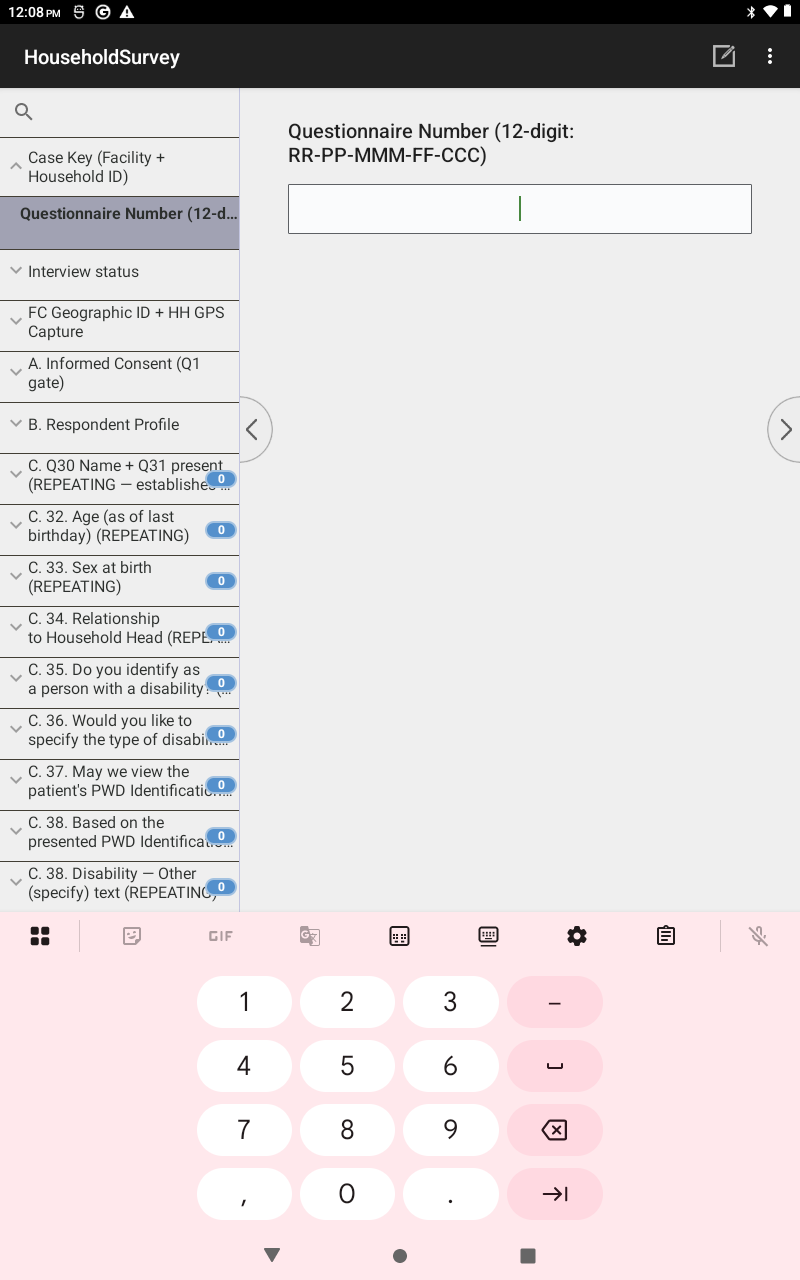
Name is an alpha free-text field; birth month (2 digits), birth year (4 digits) and confirmed age (3 digits) are number-pad entries. Age is captured as a cross-check against the birth year.
On paper
3. What is your sex at birth? · 4. Are you part of the LGBTQIA+ community? · 5. Which group do you identify with? · 6. What is your civil status?
- Q3: Male · Female
- Q4: Yes · No · Not Comfortable to Answer · Don't Know · Refused to answer
- Q5: Lesbian · Gay · Bisexual · Transgender · Queer · Intersex · Asexual · Other (specify)
- Q6: Single / Never Married · Married · Common law / Live-in · Widowed · Divorced · Separated · Annulled · Not reported
On the tablet (CAPI)
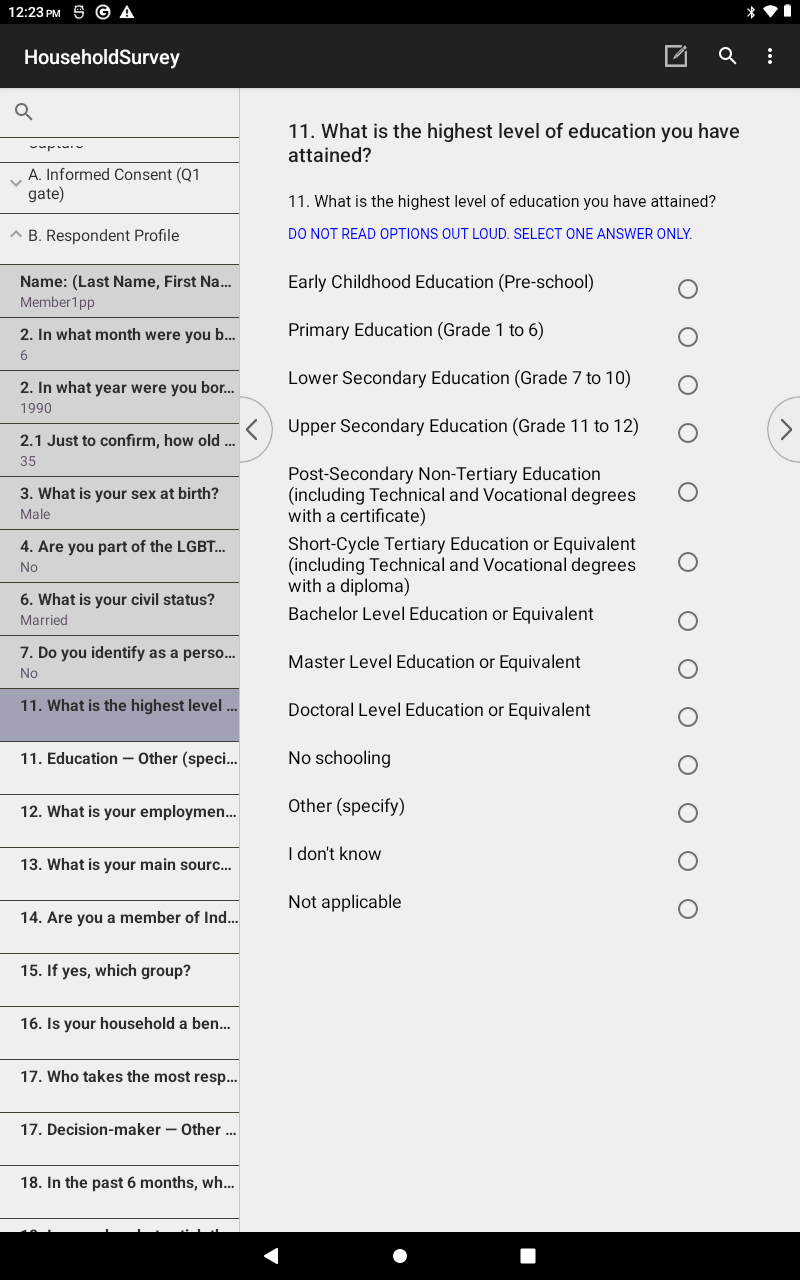
All four are single-select radios. Q5's "Other (specify)" choice gates a free-text box; the Q4/Q5 prompts explicitly reassure the respondent it is fine not to answer.
On paper
7. Do you identify as a person with a disability? · 8. Would you like to specify the type of disability? · 9. May we view your PWD Identification Card? · 10. Based on the presented PWD Identification Card, what type of disability is indicated?
- Q7: Yes · No
- Q8: Yes · No
- Q9: Yes (card presented and verified) · No (card not available) · Respondent refused to present card
- Q10: Physical (Orthopedic) · Visual · Hearing · Speech impairment · Intellectual · Psychosocial · Multiple disabilities · Other (specify)
On the tablet (CAPI)
Q7/Q8 Yes/No, Q9/Q10 single-select. This is a cascading gate: Q7=Yes opens Q8; Q8=Yes opens the PWD-card request (Q9); Q9 verified opens the disability-type list (Q10), whose "Other (specify)" gates a free-text box.
On paper
11. What is the highest level of education you have attained? · 12. What is your employment status? · 13. What is your main source of income?
- Q11: Early Childhood (Pre-school) · Primary (G1–6) · Lower Secondary (G7–10) · Upper Secondary (G11–12) · Post-Secondary Non-Tertiary · Short-Cycle Tertiary · Bachelor · Master · Doctoral · No schooling … + Other (specify) · I don't know · Not applicable
- Q12: Permanent job/own business · Short-term/seasonal/casual · Different jobs day to day · Unemployed looking · Unemployed not looking · Retired · I don't know · Not applicable
- Q13: Private company · Private household · Government · With pay in own family business/farm · Self-employed no employee · Employer in own family business · Without pay in own family business/farm · Pension … + Unemployed (looking / not looking) · I don't know
On the tablet (CAPI)
Three long single-select lists (Q11 has 13 coded options). Q11's "Other (specify)" gates a free-text box; long lists scroll on the tablet.
On paper
14. Are you a member of an Indigenous People (IP) community (e.g., Igorot, Lumad, Mangyans)? · 15. If yes, which group? · 16. Is your household a beneficiary of the Pantawid Pamilyang Pilipino Program (4Ps)? · 17. Who takes the most responsibility for making healthcare decisions in your household?
- Q14: Yes · No
- Q15: free text (IP group)
- Q16: Yes · No
- Q17: Me (respondent) · My father · My mother · My parents · My spouse/partner · My spouse/partner and I · My sibling · My grandfather · My grandmother · My uncle · My aunt · Other (specify)
On the tablet (CAPI)
Q14/Q16 Yes/No, Q17 single-select; Q15 is alpha free text. Q15 is gated by Q14=Yes (IP group only asked of IP members); Q17's "Other (specify)" gates a free-text box.
On paper
18. In the past 6 months, what is your average monthly household income? Approximate amount (₱). · 18. Income bracket — tick the category for approximate household income. · 19. How many total individuals (incl. children) live in your house now? · 20. How many non-working-age children (below 18) live in your house now? · 21. How many senior citizens live in your house now?
- Q18 amount: numeric (₱)
- Q18 bracket: Under 40,000 · 40,000–59,999 · 60,000–99,999 · 100,000–249,999 · 250,000–499,999 · 500,000 and over · Refuse to answer
- Q19 / Q20 / Q21: numeric counts
On the tablet (CAPI)
Q18 amount and Q19–Q21 counts are number-pad entries; the Q18 bracket is a single-select. On paper the bracket prints out of order (after Q23); CAPI emits it in Q-number order. Q20 (children) and Q21 (seniors) should not exceed Q19 (total).
On paper
22. Do you have electricity in your household? · 23. What is the family's main source of water supply for daily use? · 24. Do you have your own faucet, or do you share with your community? · 25. Do you have your own tube/pipe, or do you share with your community?
- Q22: Yes · No
- Q23: Faucet inside the house · Tubed/piped well · Dug well · Other (specify)
- Q24: I/we have our own · I/we share with our community
- Q25: I/we have our own · I/we share with our community
On the tablet (CAPI)
Q22 Yes/No, Q23–Q25 single-select. Q23's "Other (specify)" gates a free-text box; Q24 (faucet share) is asked when Q23 = faucet, and Q25 (tube share) when Q23 = tubed/piped well.
On paper
26. Does the family own a refrigerator/freezer? · 27. Does the family own a television set? · 28. Does the family own a washing machine? · 29. How would the socioeconomic class of your household be classified?
- Q26 / Q27 / Q28: Yes, I/we have · No, I/we don't have
- Q29: Class A or B (professionals or business with several assets) · Class C (professionals with permanent/semi-permanent income and some assets) · Class D or E (semi-permanent/informal workers with little to no assets) · I don't know
On the tablet (CAPI)
Q26–Q28 are Yes/No asset single-selects; Q29 is a single-select with long descriptive class labels. No skip logic — all four are asked of every respondent and close out the profile section.
The real printed pages
Pages 3–5 — Introduction/Consent (A) and Respondent Profile (B). Tap to open full size.
CSEntry (tablet)
Profile questions render as single-select radios, number-pad numerics, and free-text boxes, with PWD and "Other (specify)" follow-ups gated on their triggers.
On paper
30. Name (LAST NAME, FIRST NAME & MIDDLE NAME, EXT)
31. Is the HH member present or away?
- Away
- Present
32. Age (as of last birthday) — number
33. Sex at birth
- Male
- Female
34. Relationship to Household Head
- Head
- Spouse/Partner
- Son/Daughter
- Brother/Sister
- Son-In-Law/Daughter-In-Law
- Grandson/Granddaughter
- Father/Mother
- Nephew/Niece
- Cousin
- Boarder
- Domestic Helper
- Non-relative
On the tablet (CAPI)
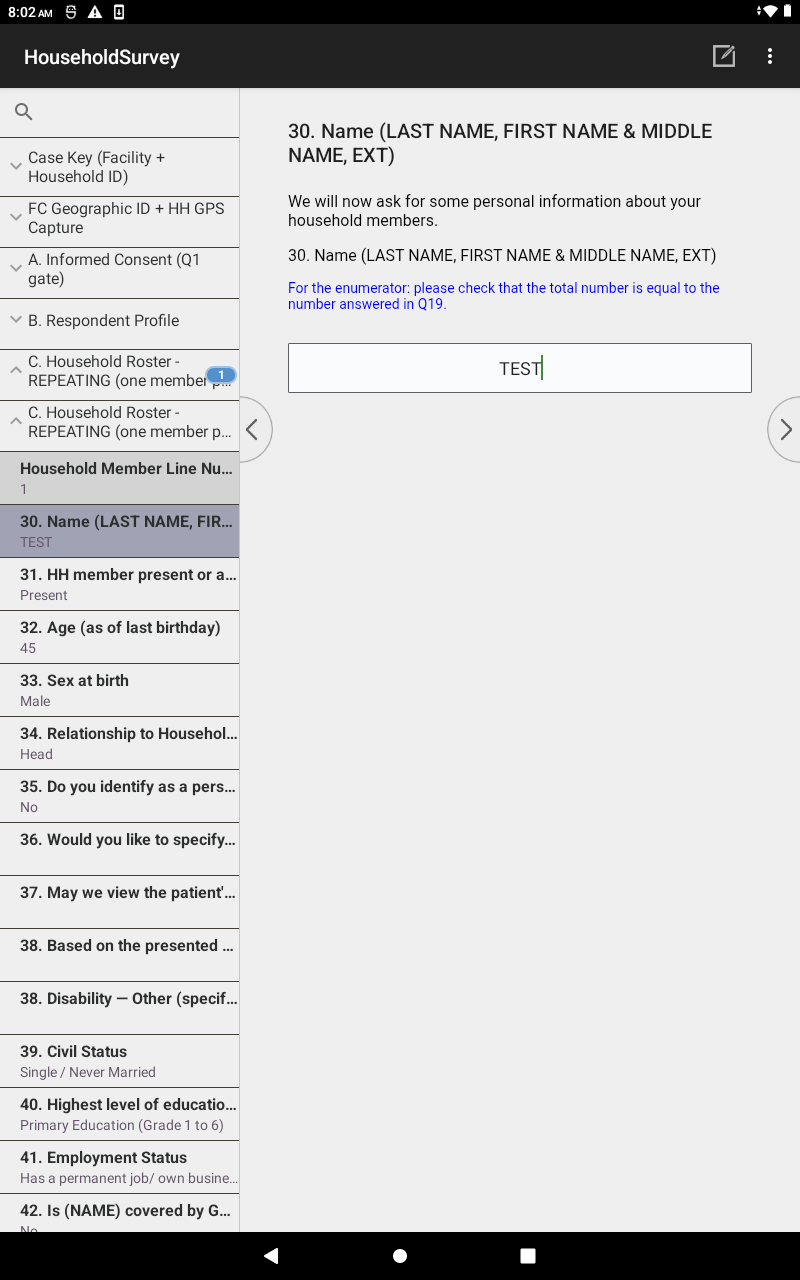
Each member gets a 2-digit line number, then name (free-text), presence, age (number-pad), sex and relationship (single-select). This roster is the loop driver — CSEntry repeats this whole screen-set once per member (record C_HOUSEHOLD_ROSTER, max 20 occurrences), capturing one member fully before advancing to the next.
On paper
35. Do you identify as a person with a disability?
- No
- Yes
36. Would you like to specify the type of disability?
- No
- Yes
37. May we view the patient's PWD Identification Card?
- No
- Yes
- Respondent refused to present card
38. Based on the presented PWD Identification Card, what type of disability is indicated?
- Physical disability (Orthopedic)
- Visual disability
- Hearing disability
- Speech impairment
- Intellectual disability
- Psychosocial disability
- Multiple disabilities
- Other disability (specify)
On the tablet (CAPI)
Disability self-ID (Q35) is the gate: only when a member is flagged as a PWD do the follow-ups (Q36 specify, Q37 card view, Q38 disability type) apply. Q38's "Other (specify)" reveals a free-text box. All within the same per-member loop.
On paper
39. Civil Status
- Single / Never Married
- Married
- Common law / Live-in
- Widowed
- Divorced
- Separated
- Annulled
- Not reported
40. Highest level of education completed
- Early Childhood Education (Pre-school)
- Primary Education (Grade 1 to 6)
- Lower Secondary Education (Grade 7 to 10)
- Upper Secondary Education (Grade 11 to 12)
- Post-Secondary Non-Tertiary Education (incl. Technical/Vocational w/ certificate)
- Short-Cycle Tertiary Education or Equivalent (incl. Technical/Vocational w/ diploma)
- Bachelor Level Education or Equivalent
- Master Level Education or Equivalent
- Doctoral Level Education or Equivalent
- No schooling
41. Employment Status
- Has a permanent job / own business
- Has a short-term, seasonal, casual job/business
- Worked on different jobs day to day per week
- Unemployed and looking for work
- Unemployed and not looking for work
- Retired
- I don't know
- Not applicable
On the tablet (CAPI)
Three long single-select pick-lists (civil status, education's 10 levels, employment's 8 states). Each is captured per member inside the same roster loop — no skips, every member answers all three.
On paper
42. Is (NAME) covered by GSIS either as a member or dependent?
43. Is (NAME) covered by SSS either as a member or dependent?
44. Is (NAME) covered by Pag-ibig either as a member or dependent?
45. Currently registered with PhilHealth?
- Yes
- No
- I don't know
46. What is his/her membership category?
- Formal economy
- Informal economy
- Indigent
- Sponsored
- Lifetime member
- Senior citizen
- Overseas Filipino Worker (OFW)
- Qualified dependents
- Dependent
- Other (Specify)
- I don't know
On the tablet (CAPI)
Q42–Q45 are Yes / No / I-don't-know single-selects; the member's name is piped into the prompt via a fill. Q45 (PhilHealth registered) gates Q46 — the membership-category list only appears for registered members, and its "Other (Specify)" reveals a free-text box. Still inside the per-member loop.
On paper
47. Do you or other members of your HH have private insurance? (household-level — asked once)
- No
- Yes
48. Name (First Name Only)
49. Is (NAME) covered by a private health insurance either as a member or dependent? (Example: Maxicare, Intellicare, Pacific Cross Health Care)
- Yes
- No
- I don't know
50. Others (Specify)
On the tablet (CAPI)
Q47 is a single household-level Yes/No (its own non-repeating record C_HH_PRIVATE_INS_GATE). It gates the whole Q48–Q50 sub-roster: only if Q47 = Yes does CSEntry collect, per member, first name (Q48), private-insurance coverage (Q49 Yes/No/DK), and an "Others (Specify)" text (Q50).
The real printed pages
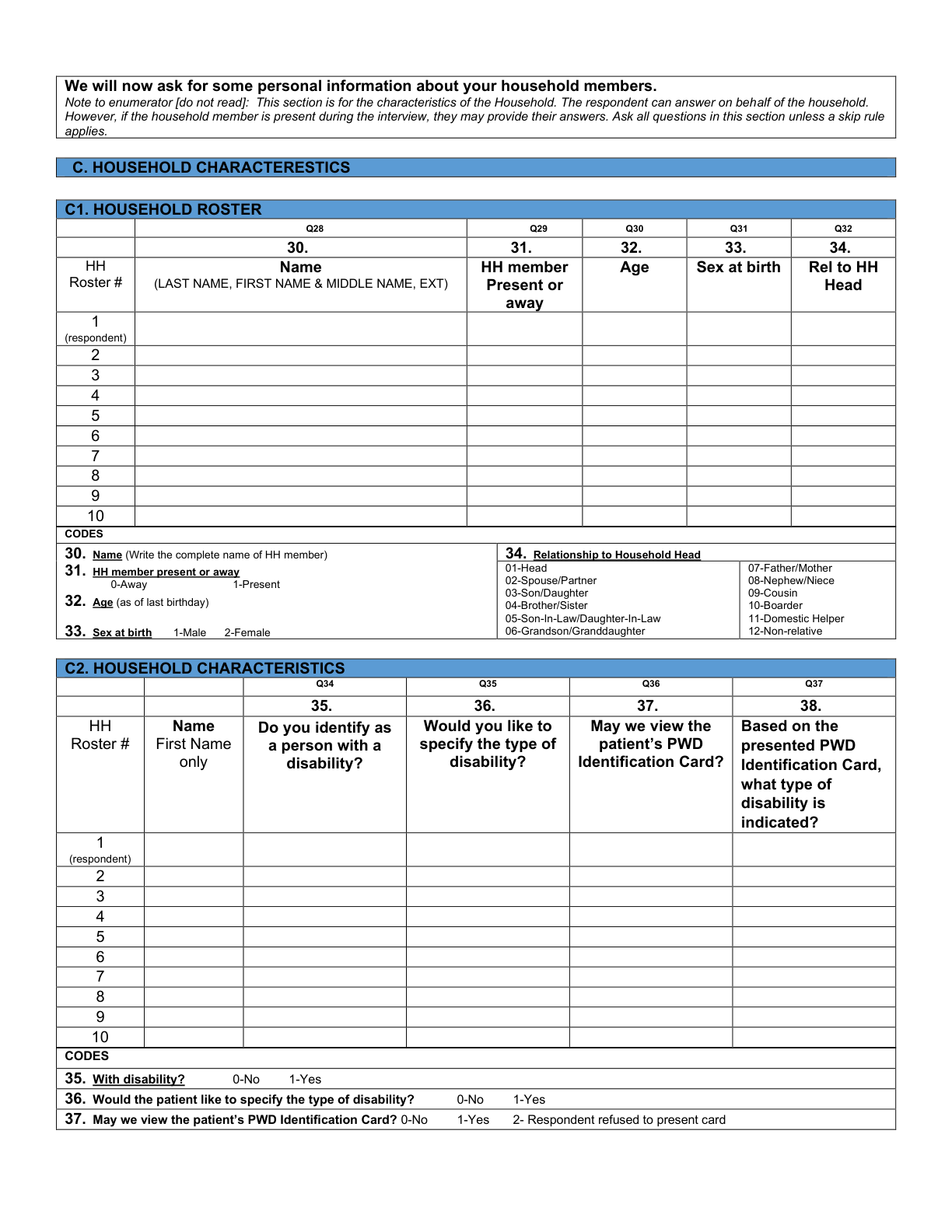
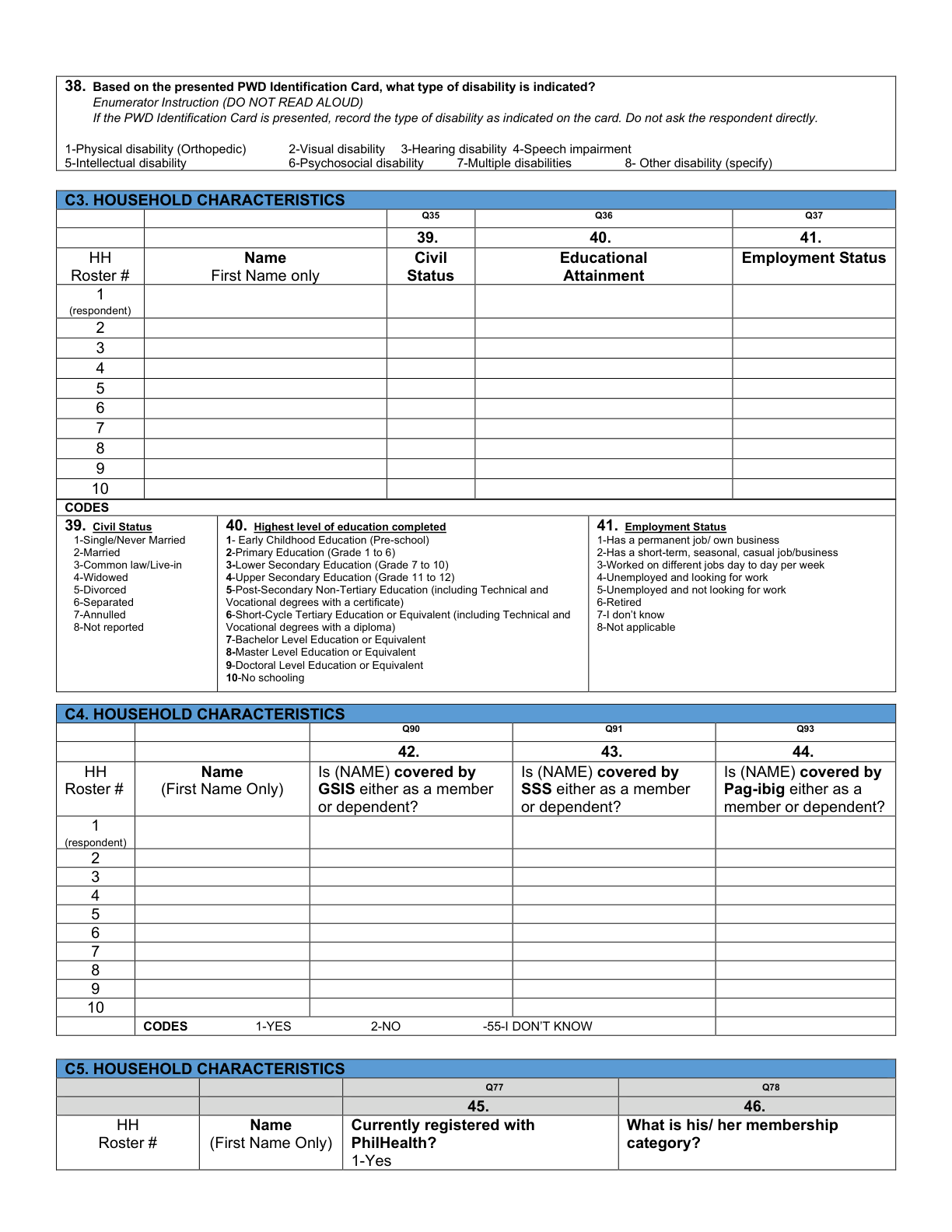
Pages 6–7 — Household Characteristics (roster). Tap to open full size.
CSEntry (tablet)
Live roster capture shown. The household size drives a repeating roster — CSEntry loops one screen-set per member (name, relationship, age, sex, disability, insurance, …), each member captured fully before moving to the next, up to 20 members.
On paper
51. Have you heard about Universal Health Care (UHC) prior to this survey?
- No
- Yes
52. What is your source of information about UHC? (select all that apply)
- News
- Legislation
- Social Media
- Friends / Family
- Health center/facility
- LGU/Barangay
- I don't know
- Other (Specify)
53. What is your understanding about UHC? (select all that apply)
- Protection from financial risk / decreased out-of-pocket spending
- Access to quality and affordable health care goods and services
- Automatic enrollment into PhilHealth
- Primary care provider for every Filipino
- I don't know
- Other (Specify)
On the tablet (CAPI)
Q51 is a Yes/No single-select. Q51 gates the rest: only when UHC was heard of do the two check-box multi-selects appear — Q52 (source, 8 options) and Q53 (understanding, 6 options). Both are true check-box controls (tap multiple), and each "Other (Specify)" reveals a free-text box.
The real printed pages
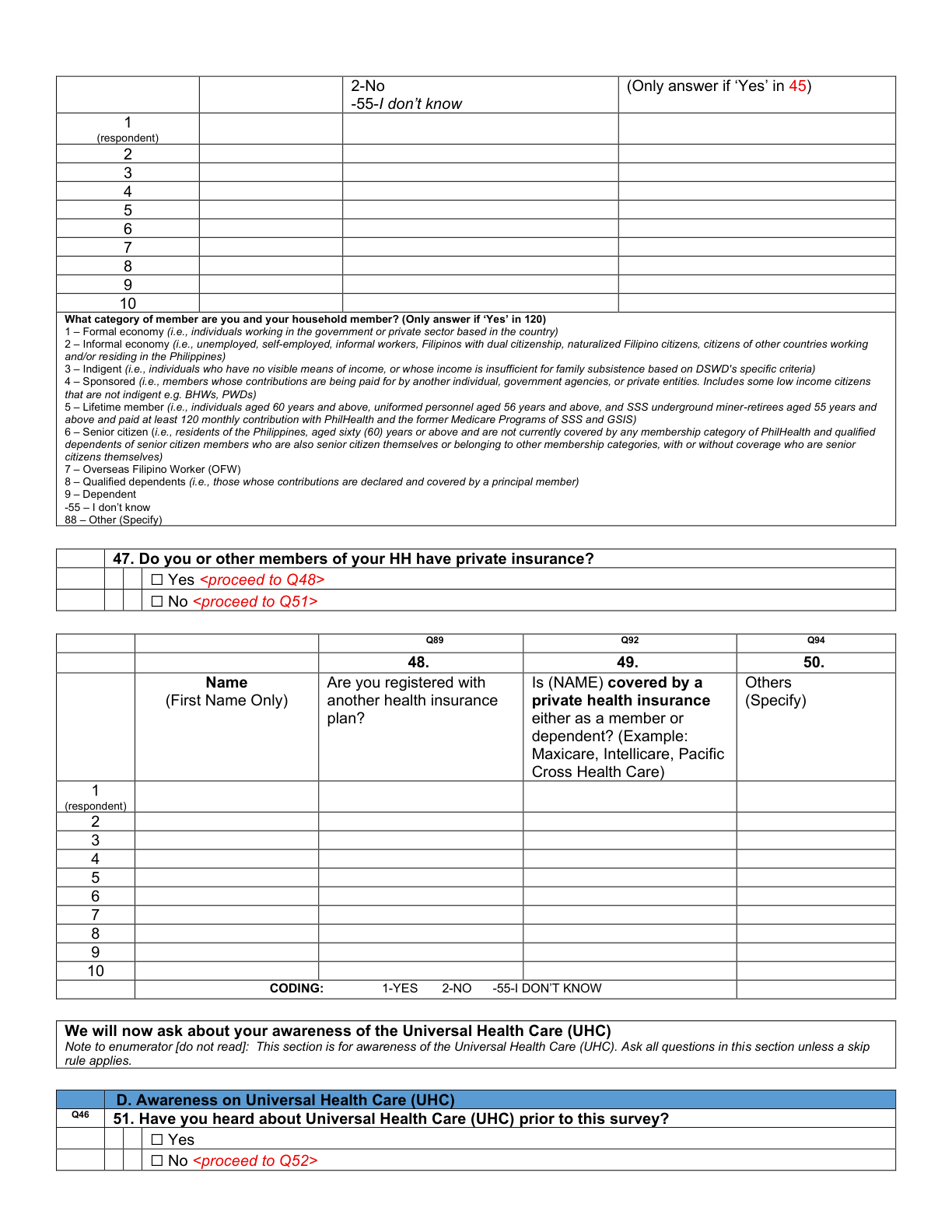
Page 8 — Awareness on Universal Health Care. Tap to open full size.
CSEntry (tablet)
A Yes/No gate (Q51) followed by two check-box multi-selects with optional free-text "Other" capture.
On paper
54. Have you heard of the term "YAKAP/Konsulta package"?
- Yes
- No
On the tablet (CAPI)
A single Yes/No toggle. This is the gate for the whole section: if "No", the tablet skips Q55–Q56 and moves on.
On paper
55. What are your sources of information about the YAKAP/Konsulta package?
- News
- Legislation
- Social Media
- Friends / Family
- Health center/facility
- LGU/Barangay
- I don't know
- Other (Specify) — with text box
On the tablet (CAPI)
Check-box multi-select — tick all that apply. Only shown when Q54 = Yes. Ticking "Other (Specify)" opens a free-text box.
On paper
56. What is your understanding about the YAKAP/Konsulta package?
- Free primary care consultation (with a registered YAKAP/Konsulta provider)
- Free health risk screening and assessment (with a registered YAKAP/Konsulta provider)
- Free selected laboratory / diagnostics examination
- Free selected drugs and medicines
- There are no benefits in the package
- I don't know
- Other (Specify) — with text box
On the tablet (CAPI)
Check-box multi-select — tick all that apply. Only shown when Q54 = Yes. Ticking "Other (Specify)" opens a free-text box.
The real printed page
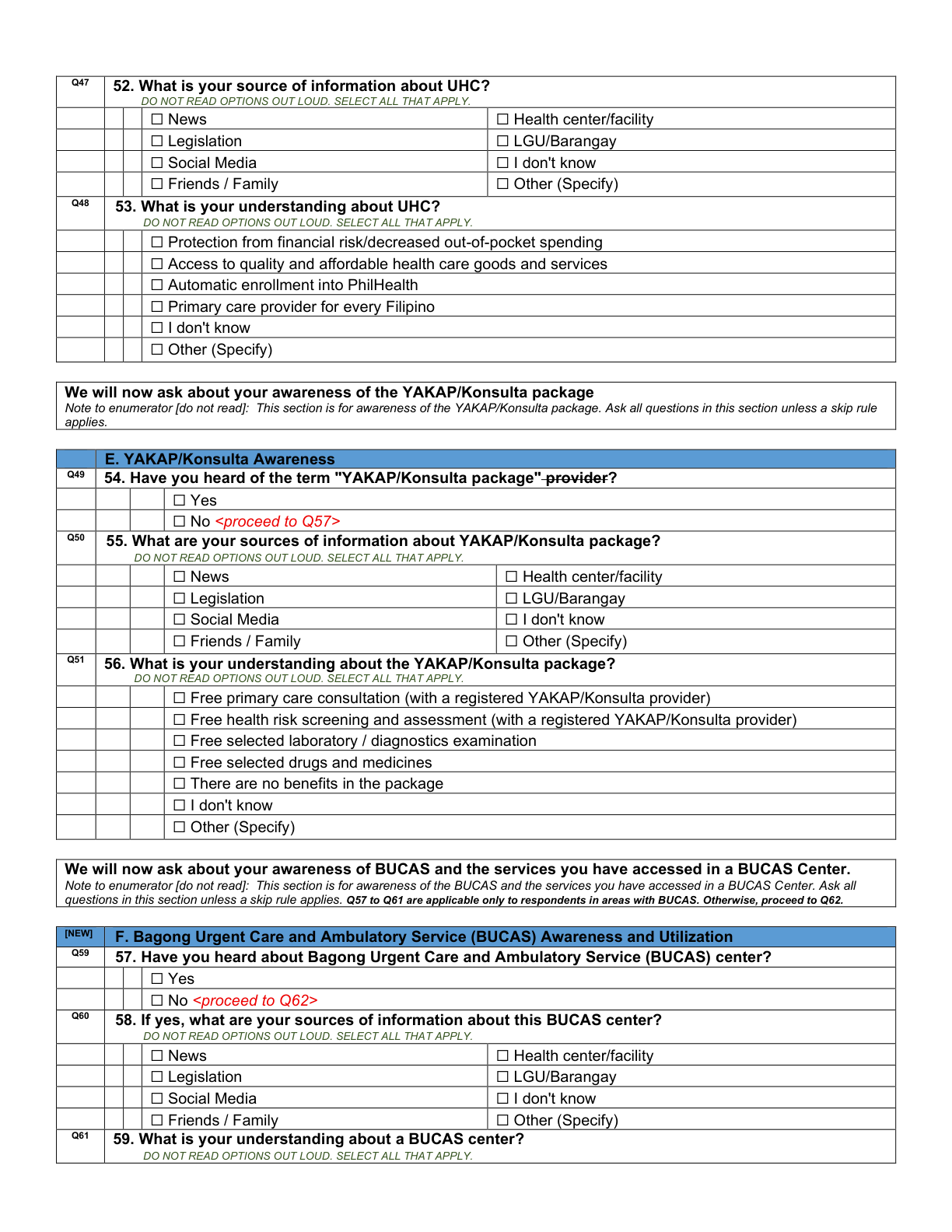
Page 9 — YAKAP/Konsulta (E) and BUCAS Awareness (F). Tap to open full size.
CSEntry (tablet)
A Yes/No gate (Q54) opens two check-box multi-selects (Q55, Q56), each with an Other-specify text box.
On paper
57. Have you heard about Bagong Urgent Care and Ambulatory Service (BUCAS) center?
- Yes
- No
58. If yes, what are your sources of information about this BUCAS center?
- News
- Legislation
- Social Media
- Friends / Family
- Health center/facility
- LGU/Barangay
- I don't know
- Other (Specify) — with text box
59. What is your understanding about a BUCAS center?
- Provides urgent care for non-life-threatening/serious conditions
- Offers outpatient and ambulatory health services
- Helps reduce overcrowding in hospitals
- Allows access to timely medical consultation and treatment
- Other (specify) — with text box
On the tablet (CAPI)
Q57 is a Yes/No gate; if "No", the tablet skips Q58–Q59. Q58 and Q59 are check-box multi-selects, each with an Other-specify text box. This whole section applies only to respondents in areas with BUCAS; otherwise the tablet proceeds to Q62.
On paper
60. In the last six months, did you or any member of your HH accessed the services in a BUCAS center?
- Yes
- No
61. If yes, which of the services did you avail?
- Medical consultation for urgent or minor conditions
- Outpatient or ambulatory care services
- Basic diagnostic services (e.g., laboratory tests, X-ray)
- Minor procedures or treatments
- Referral to higher-level health facilities
- I don't know
- Other (specify) — with text box
On the tablet (CAPI)
Q60 is a Yes/No gate; if "No", the tablet skips the Q61 services check-box. Q61 is a check-box multi-select with an Other-specify text box.
The real printed page
Page 9 — YAKAP/Konsulta (E) and BUCAS Awareness (F). Tap to open full size.
CSEntry (tablet)
Two Yes/No gates (Q57, Q60) each open follow-up check-box multi-selects (Q58/Q59 and Q61); the section is shown only in BUCAS areas.
On paper
62. How often do you purchase or receive medicines? · 63. Was the most recent medicine purchased prescribed by a doctor or over-the-counter (OTC) medicine (no need for a prescription)? · 64. What are the medications that you or any member of your household usually take? (List all medicines taken for the health condition.)
- Q62: Weekly · Bi-weekly · Monthly · Rarely · Never
- Q63: Prescribed by a doctor · Over-the-counter medicine · Purchased both prescribed medicine and OTC medicine · I don't know
- Q64: free-text list (up to 500 chars)
On the tablet (CAPI)
Q62/Q63 are single-select radio screens; Q64 is a free-text box. Q62 = Never skips the rest of the buying questions and jumps ahead to Q69 (GAMOT awareness) — there is nothing to ask about a purchase that never happens.
On paper
65. What are the medical conditions that you/your household member/s take the medicine/s for? · 66. Where do you usually buy or receive your medicines?
- Q65: Upper respiratory infection · Hypertension · Immunization · Pregnancy or birth · Flu · Fever · Joint and muscle pain · Asthma or COPD · Diabetes · Heart problem · Kidney problem / Dialysis · Cancer (any) · Gastro problem · Other infection · Accident/injury · Dental · ENT · Allergy · No condition – Regular check-up only · Other (Specify)
- Q66: Public Hospital · Private Hospital · Chain Pharmacies (Mercury Drug, Watsons, TGP, Generika) · Local pharmacies · Online stores (Shopee, Lazada) · Barangay Health Station · Rural Health Unit or City Health Office · Other (specify)
On the tablet (CAPI)
Both are check-box multi-selects (tick all that apply). Ticking "Other" on either question opens its own Other-specify text box; leave it unticked and the box stays hidden.
On paper
67. How much time does it take to reach the nearest pharmacy from your home? (Hours / Minutes) · 68. How easy is it for you to access a pharmacy or drugstore?
- Q67: two number boxes — Hours (0–99) · Minutes (0–99)
- Q68: Very difficult · Difficult · Neutral · Easy · Very easy
On the tablet (CAPI)
Q67 is a pair of two-digit number-pad fields (hours then minutes); Q68 is a single-select scale. No skips here — both are always asked when the buying block runs.
On paper
69. Have you heard of the Guaranteed and Accessible Medications for Outpatient Treatment (GAMOT) Package, which is part of PhilHealth's YAKAP/Konsulta or primary care benefit package? · 70. If yes, what are your sources of information for GAMOT Package? · 71. What is your understanding of the GAMOT Package?
- Q69: Yes · No
- Q70: News · Legislation · Social Media · Friends / Family · Health center/facility · LGU/Barangay · I don't know · Other (Specify)
- Q71: Provides free or affordable medicines for outpatients · Ensures continuous availability of essential medicines · Helps reduce out-of-pocket expenses for medicines · Supports treatment of common illnesses and chronic conditions · I don't know · Other (specify)
On the tablet (CAPI)
Q69 is a Yes/No gate; Q70 and Q71 are check-box multi-selects. Q69 = No skips the info-source and understanding questions (Q70–Q71) — sources/understanding only make sense once the respondent has heard of GAMOT.
On paper
72. Did you get the medicines from the GAMOT Package during the past 6 months? · 73. What are the medications that you obtained from the GAMOT Package? [LIST] · 74. Where did you get the rest of the medicines?
- Q72: Yes · No
- Q73: free-text list (up to 500 chars)
- Q74: Purchased from pharmacy · from public hospital · from private hospital · from primary care provider (PCP) · Received from PCP for free · from LGU for free · from public hospital for free · from private hospital for free · Not applicable · Other (Specify)
On the tablet (CAPI)
Q72 is a Yes/No gate, Q73 a free-text list, Q74 a check-box multi-select with an Other-specify box. Q72 = No skips Q73 (no GAMOT meds list to capture); Q74 then captures where the remaining medicines were sourced.
On paper
75. Do you know the difference between a 'branded' and a 'generic' medicine? · 76. Was/were the medicine/s you bought outside of GAMOT pharmacy branded or generic?
- Q75: Yes · No
- Q76: Branded · Generic · Both branded and generic · Not applicable
On the tablet (CAPI)
Q75 is a Yes/No gate; Q76 is a single-select. Q76 is only asked when Q75 = Yes (the "Don't know the difference" option was removed as contradictory, #646). Branded routes to Q78, Not applicable jumps to Q79.
On paper
77. If generic, why did you buy generic medicine? · 78. If branded, why did you buy branded medicine? (Ask if answer in Q76 is branded and both branded and generic, otherwise skip.)
- Q77: Lower cost · Prescribed by doctor · Readily available · Given for free · More or as effective as branded medicine · I don't know · Other (Specify)
- Q78: Branded medicine is more effective than generic · Not aware of generic option · Prescribed by doctor · Given for free · Prefer branded over generic option · I don't know · Other (Specify)
On the tablet (CAPI)
Both are check-box multi-selects with Other-specify boxes. Q77 is asked only when Q76 = Generic / Both; Q78 only when Q76 = Branded / Both — the two why-questions are mutually gated on Q76 so each is skipped when it does not apply.
The real printed pages
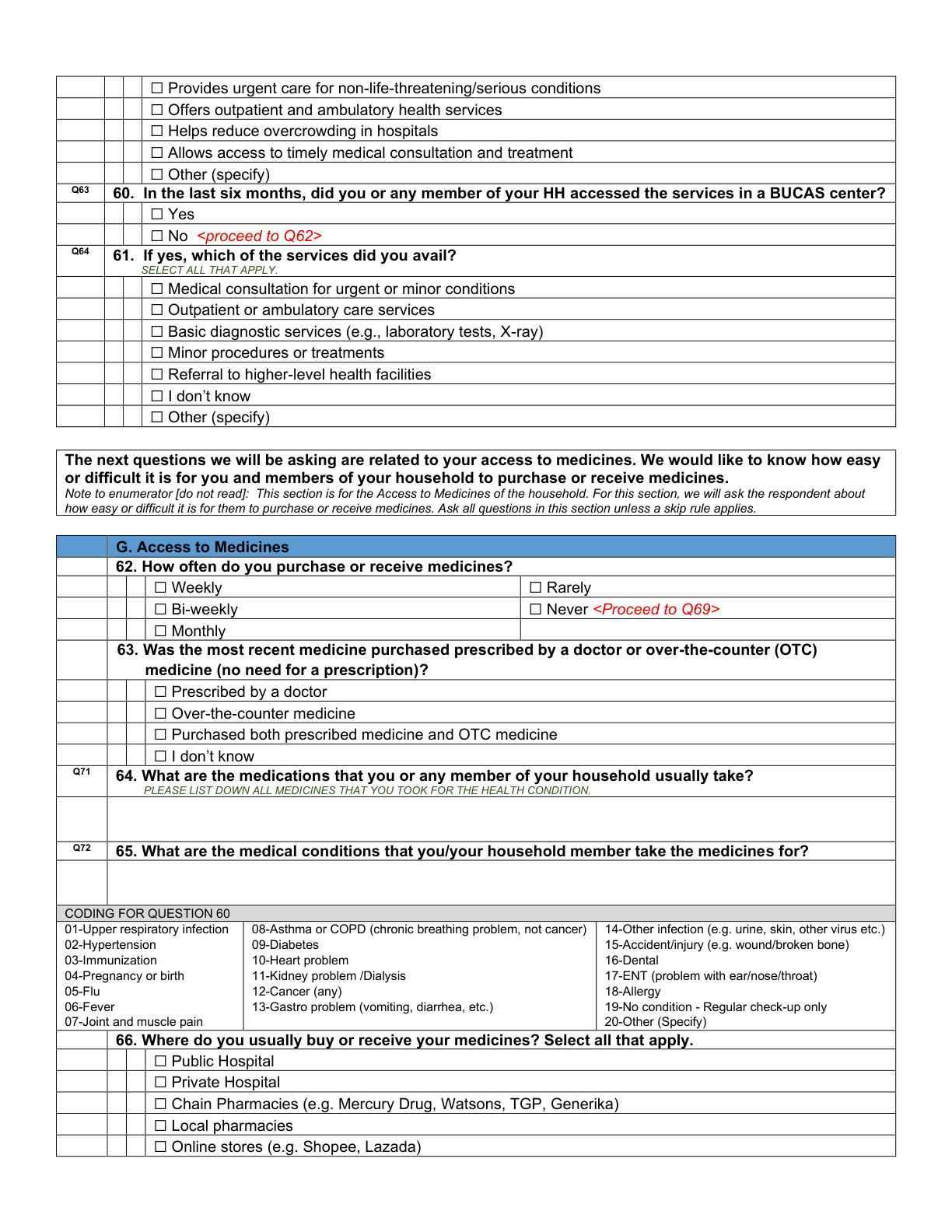
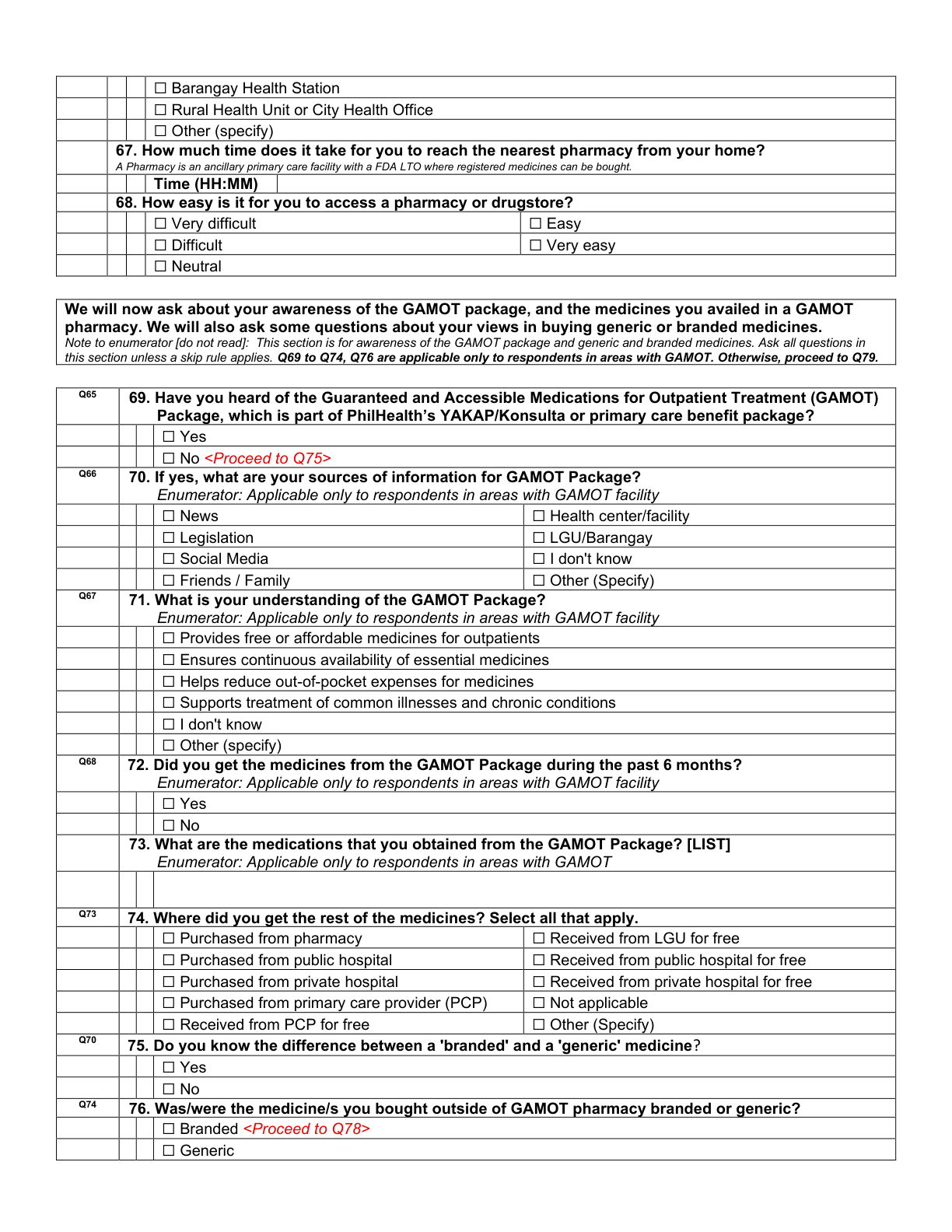
Pages 10–11 — Access to Medicines. Tap to open full size.
CSEntry (tablet)
Single-select gates (Q62, Q63, Q68, Q75, Q76) drive the skips; check-box multi-selects (Q65, Q66, Q70, Q71, Q74, Q77, Q78) capture all-that-apply.
On paper
79. How did you find out about how to register to PhilHealth? · 80. Who assisted you in the registration process?
- Q79: PhilHealth representative · LGU · Primary care provider · Other health care provider · Employer · No one / self-registered · Barangay Health Worker · Friends / Family · Health center/facility · Other (Specify)
- Q80: same list as Q79 (PhilHealth representative … Other (Specify))
On the tablet (CAPI)
Both are single-select long lists sharing the same option set; each carries its own Other-specify text box. Picking "Other (Specify)" opens the box; the whole section is reached only when the respondent is registered with PhilHealth per Q45.
On paper
81. Did you have any difficulties in the registration process? · 82. What did you find difficult about the process?
- Q81: Yes · No
- Q82: Unclear process · Took a long time · Did not know where to ask for help · Had to travel a long way · No valid ID · Did not know the required documents to register · I don't know · Other (Specify)
On the tablet (CAPI)
Q81 is a Yes/No gate; Q82 is a check-box multi-select with an Other-specify box. Q81 = No skips Q82 — no difficulty reasons are collected when registration was not difficult.
On paper
83. Would you know where to go to seek assistance in registration? · 84. Where would you go to seek assistance?
- Q83: Yes · No
- Q84: free-text (up to 200 chars)
On the tablet (CAPI)
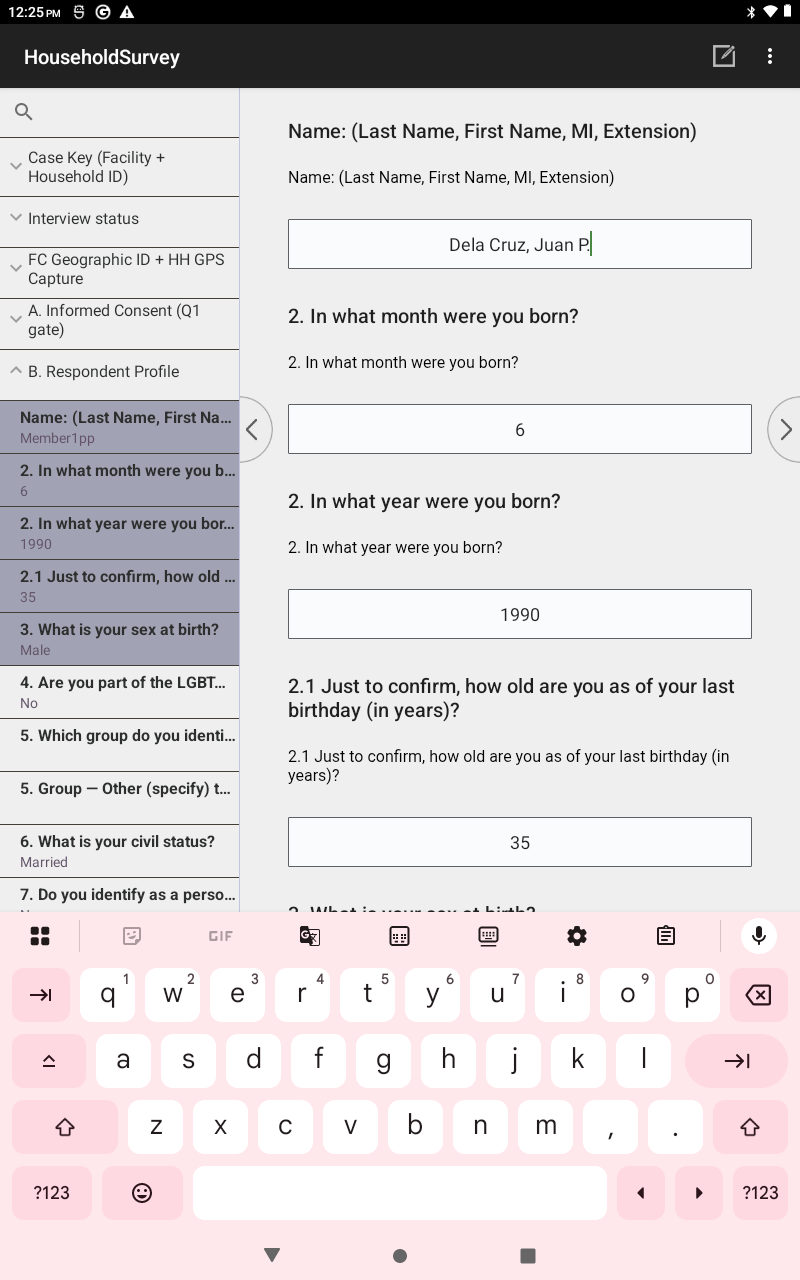
Q83 is a Yes/No gate; Q84 is a free-text box. Q84 is only asked when Q83 = Yes — if they don't know where to go, there is no place to name.
On paper
85. What are some of the benefits that come with being a PhilHealth member?
- Q85: No balance billing for basic ward accommodation · Subsidized inpatient services · Subsidized outpatient services · There are no benefits to being a member · I don't know · Other (Specify)
On the tablet (CAPI)
Check-box multi-select (tick all known benefits) with an Other-specify box. No gate — asked of every registered respondent; ticking "Other" reveals the text box.
On paper
86. Do you and members of your HH pay PhilHealth premiums every month? · 87. Do you find it difficult to pay the PhilHealth premiums every month? · 88. Why did you find it difficult?
- Q86: Yes, I pay directly · Yes, my employer pays · No, I do not pay premiums
- Q87: Yes · No
- Q88: Cannot afford the premium · Payment options are inconvenient · No time to pay · Don't see value in paying · System of PhilHealth is unreliable/usually down · I don't know · Other (Specify)
On the tablet (CAPI)
Q86 is a single-select, Q87 a Yes/No gate, Q88 a check-box multi-select with an Other-specify box. Q87 = No skips Q88 — the "why difficult" reasons are only captured when paying premiums is found difficult.
The real printed pages
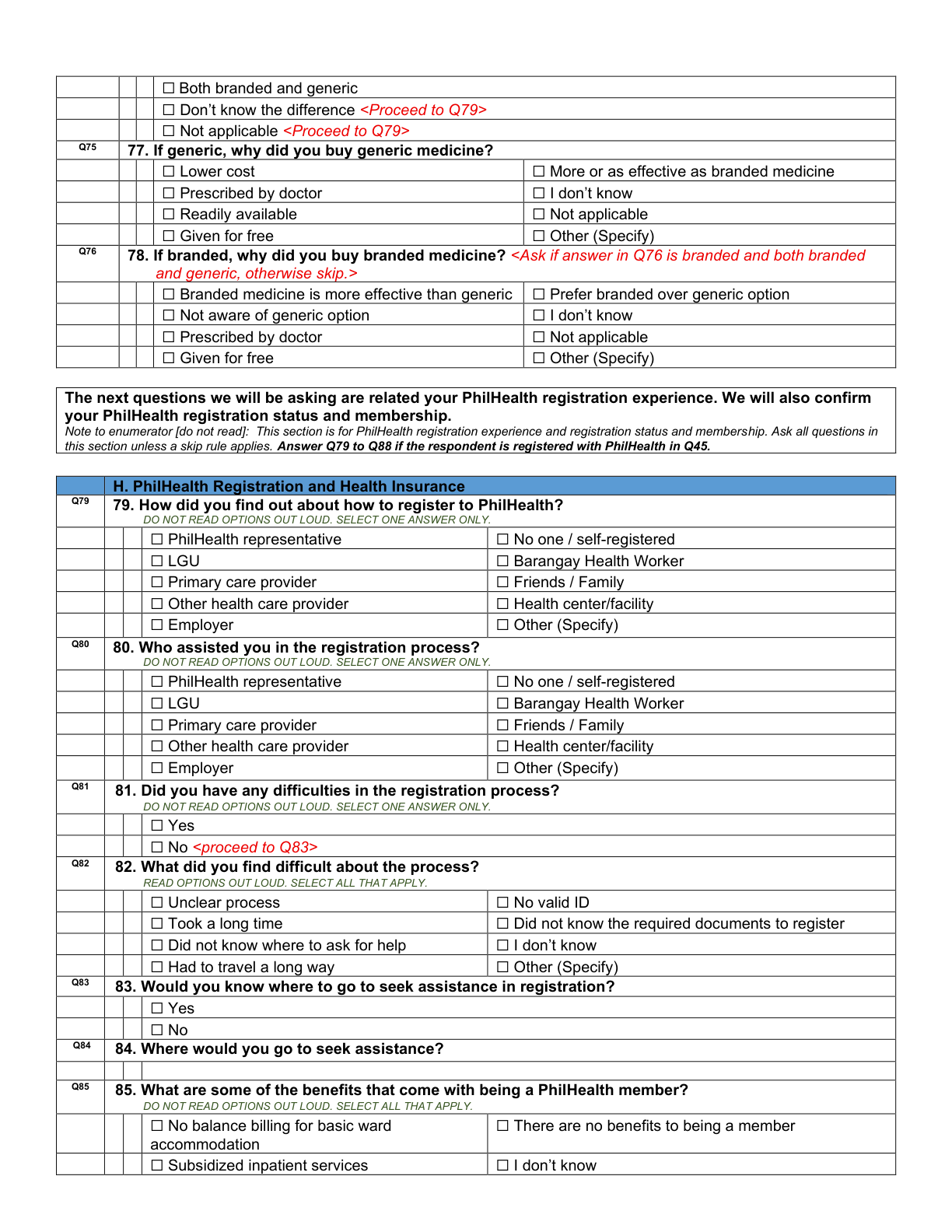
Page 12 — PhilHealth Registration and Health Insurance. Tap to open full size.
CSEntry (tablet)
Single-select long lists (Q79, Q80) and Yes/No gates (Q81, Q83, Q87) drive the skips; check-box multi-selects (Q82, Q85, Q88) capture all-that-apply.
On paper
89. In the past 12 months, do you have a clinic, or health center that you usually go to? · 89.1. What is the name of the facility? · 90. Is this the facility you usually go to for general health concerns?
- Q89: Yes · No · Don't know
- Q89.1: free-text facility name (up to 120 chars)
- Q90: Yes · No
On the tablet (CAPI)
Q89 is a Yes/No/Don't-know single-select. Q89.1 facility name and Q90 are gated by Q89 = Yes — if there's no usual facility, the interviewer skips to the why-not item (Q93).
On paper
91. Why did you go to this facility? · 92. What is the type of facility that you usually go to? · 93. If not, why do you not have a usual clinic, or health center that you usually go to?
- Q91 (tick all): more accessible than usual · service/specialist not at usual · recommended by friends/family · wanted to try another · prefer this one · referred by usual facility · usual closed today · trusted doctor transferred here · Other (Specify)
- Q92 (one): YAKAP/Konsulta or primary care provider · Barangay Health Center · Rural Health Unit / Health Center · Public Hospital · Private Hospital · Private Clinic · Traditional Healer or Manghihilot/Albularyo · I don't know · Other (Specify)
- Q93 (tick all): I don't get sick · recently moved into the area · it's expensive · I can treat myself · don't know where to go · I don't know · Other (Specify)
On the tablet (CAPI)
Q92 facility type is a long single-select (shown). Q91 and Q93 are check-box multi-selects, each with an Other-specify text box that opens only when "Other" is ticked. Q91 (why this facility) is asked when Q89/Q90 say they do have a usual facility; Q93 (why no usual facility) is the mirror branch for Q89 = No.
On paper
94. What mode/s of transportation do you use when travelling to the nearest primary care facility? · 95. How long does it take you to travel from your house … (one-way, minutes)? · 96. How much does it usually cost … (PHP, one-way)?
- Q94 (tick all): Walk · Bike · Public Bus · Jeepney · Tricycle · Car (incl. private taxi/cab) · Motorcycle · Boat · Taxi · Pedicab · E-bike · Other (Specify)
- Q95: minutes, number up to 3 digits
- Q96: PHP, number up to 5 digits
On the tablet (CAPI)
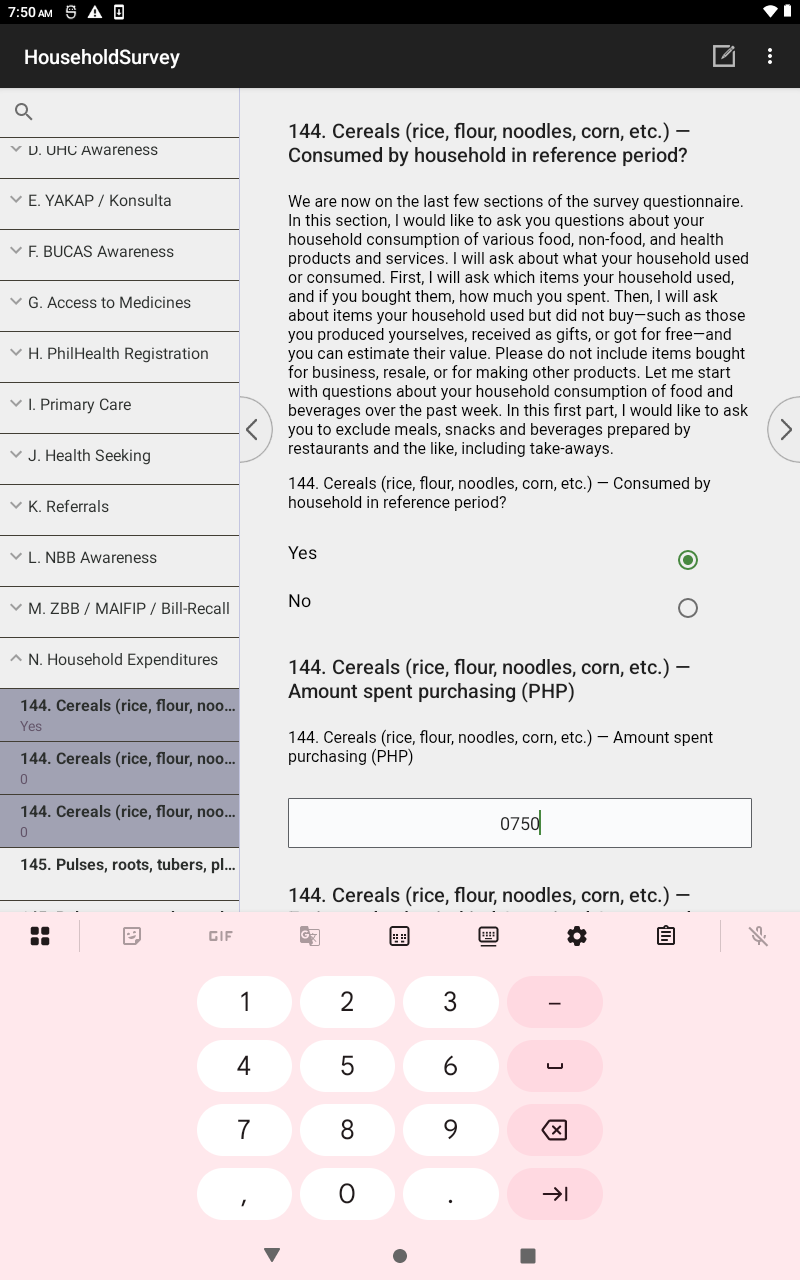
Q95 (minutes) and Q96 (PHP) are number-pad entries (shown). Q94 transport is a check-box multi-select with an Other-specify text box gated on ticking "Other"; multiple modes can be selected for a single trip.
On paper
97. When you have a health problem, do you know how to book an appointment at a primary care facility? · 98. When your primary care facility is open, can you get advice quickly over the phone …? · 99. When your primary care facility is closed, is there a phone number you can call …? · 100. When you have to visit your primary care facility, do you have to take a leave from work or school to go?
- Q97: Yes · No
- Q98 & Q99: Yes · No · I haven't tried · I don't know
- Q100: Yes · No · I haven't tried · I don't know · Not applicable
On the tablet (CAPI)
Q97 is Yes/No; Q98–Q100 are short single-selects (shown). Q100 adds a "Not applicable" code; these closing items are asked of all respondents with no further branching, ending Section I.
The real printed page
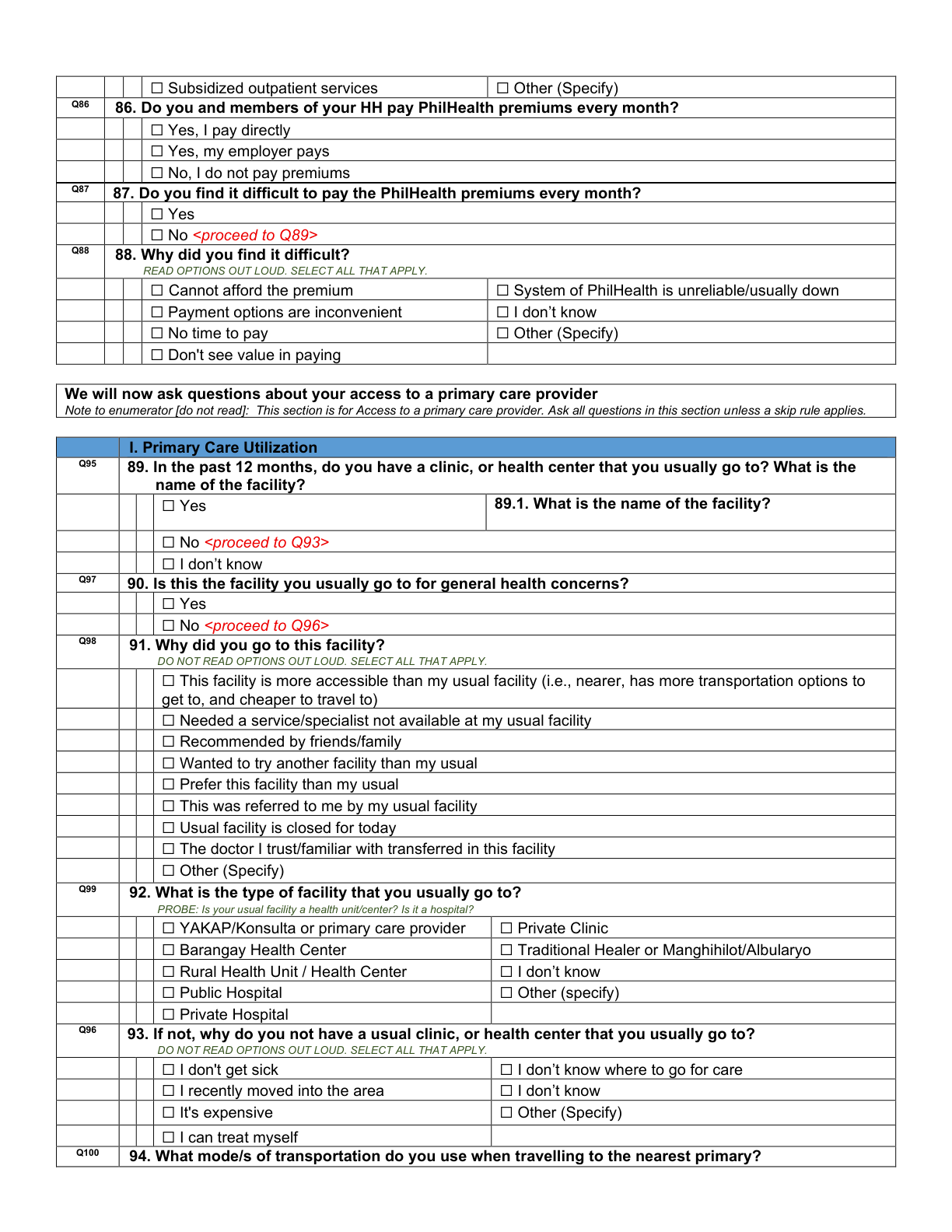
Page 13 — Primary Care Utilization. Tap to open full size.
CSEntry (tablet)
Mix of Yes/No, single-select, number-pad and check-box controls; usual-facility branch (Q89) drives the Q91 vs Q93 split.
On paper
101. How often do you/your household member have a general check-up on your health (i.e., when you feel healthy, without any specific illness)? · 102. What best describes why you/your household member will visit a health facility (e.g. RHU, health center, clinic, hospital)?
- Q101 (one): More than once a year · Every year · Every 2–3 years · Every 4–5 years · No set time; only once or twice in my life · Never; only when sick · Other (Specify)
- Q102 (tick all): Consultation for new health problem · Follow-up an ongoing problem · For tests/diagnostics only · For a general check-up · Health certificate/administrative reason · For immunizations/vaccinations · My doctor transferred here · Other (Specify)
On the tablet (CAPI)
Q101 is a long single-select (shown) with an Other-specify text box. Q102 is a check-box multi-select; its Other-specify text box opens only when "Other" is ticked.
On paper
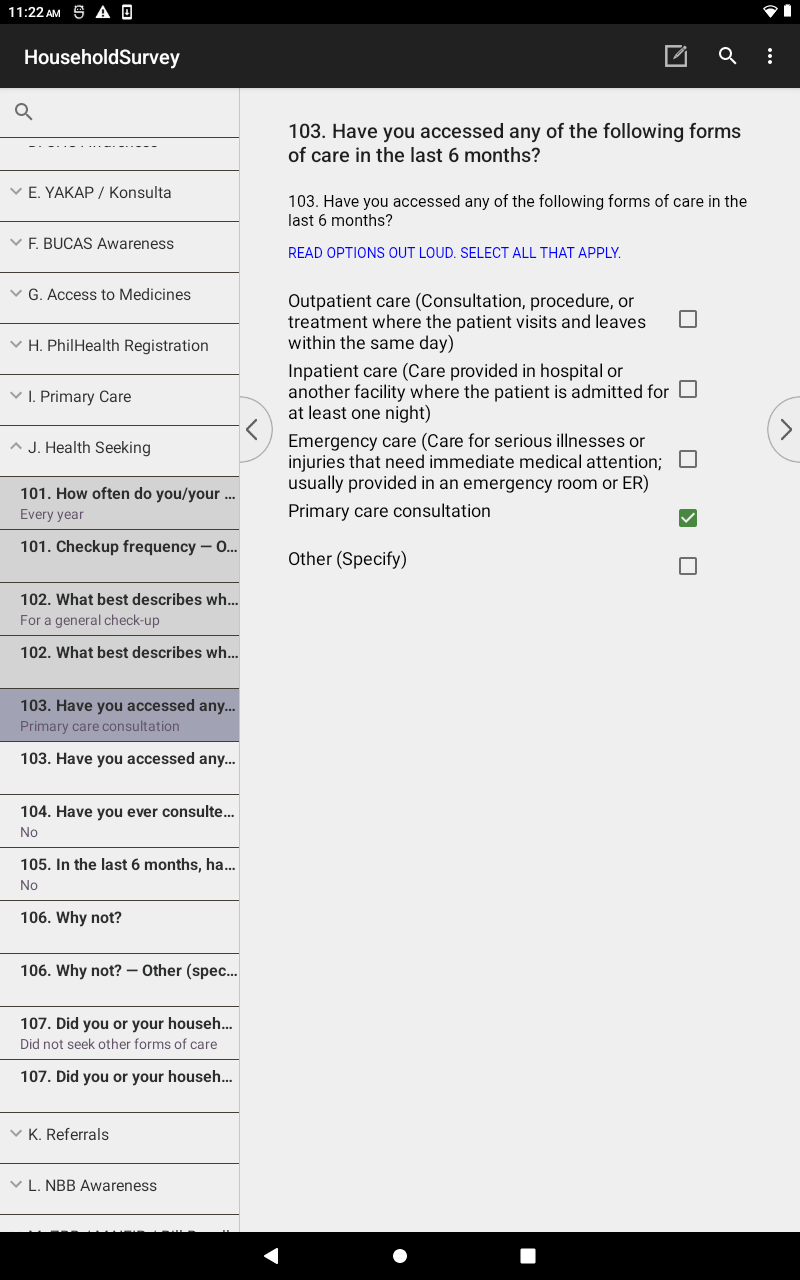
103. Have you accessed any of the following forms of care in the last 6 months?
- Q103 (tick all): Outpatient care (visit and leave the same day) · Inpatient care (admitted at least one night) · Emergency care (immediate attention, usually in an ER) · Primary care consultation · Other (Specify)
On the tablet (CAPI)
Q103 is a check-box multi-select with an Other-specify text box. No skip — asked of all respondents; multiple care types may be ticked for the 6-month window.
On paper
104. Have you ever consulted a physician for preventative reasons, such as to consult about your lifestyle, weight loss, stopping smoking, etc.? · 105. In the last 6 months, have you or any of your household members had a medical problem and chosen NOT to see a healthcare provider?
- Q104: Yes · No
- Q105: Yes · No
On the tablet (CAPI)
Both are Yes/No single-selects (shown). Q105 is the gate for Q106: Q105 = No skips Q106 ("why not") and jumps straight to Q107; only Q105 = Yes asks why care was forgone.
On paper
106. Why not? · 107. Did you or your household members do any other actions to improve your/their health condition or address your/their health concern?
- Q106 (tick all): Not sick enough · It's too expensive · Could not take time off work · Could not get an appointment soon enough · No transportation available · Afraid to know my illness · I don't know · Other (Specify)
- Q107 (tick all): Visited other healthcare facility · Sought alternative care (reflexology, acupuncture, herbal medicines, etc.) · Sought telemedicine · Used home care · Bought medicine from a pharmacy · Did not seek other forms of care · Other (Specify)
On the tablet (CAPI)
Q106 and Q107 are check-box multi-selects, each with an Other-specify text box gated on "Other". Q106 is reached only when Q105 = Yes; Q107 is then asked of everyone and closes Section J.
The real printed page
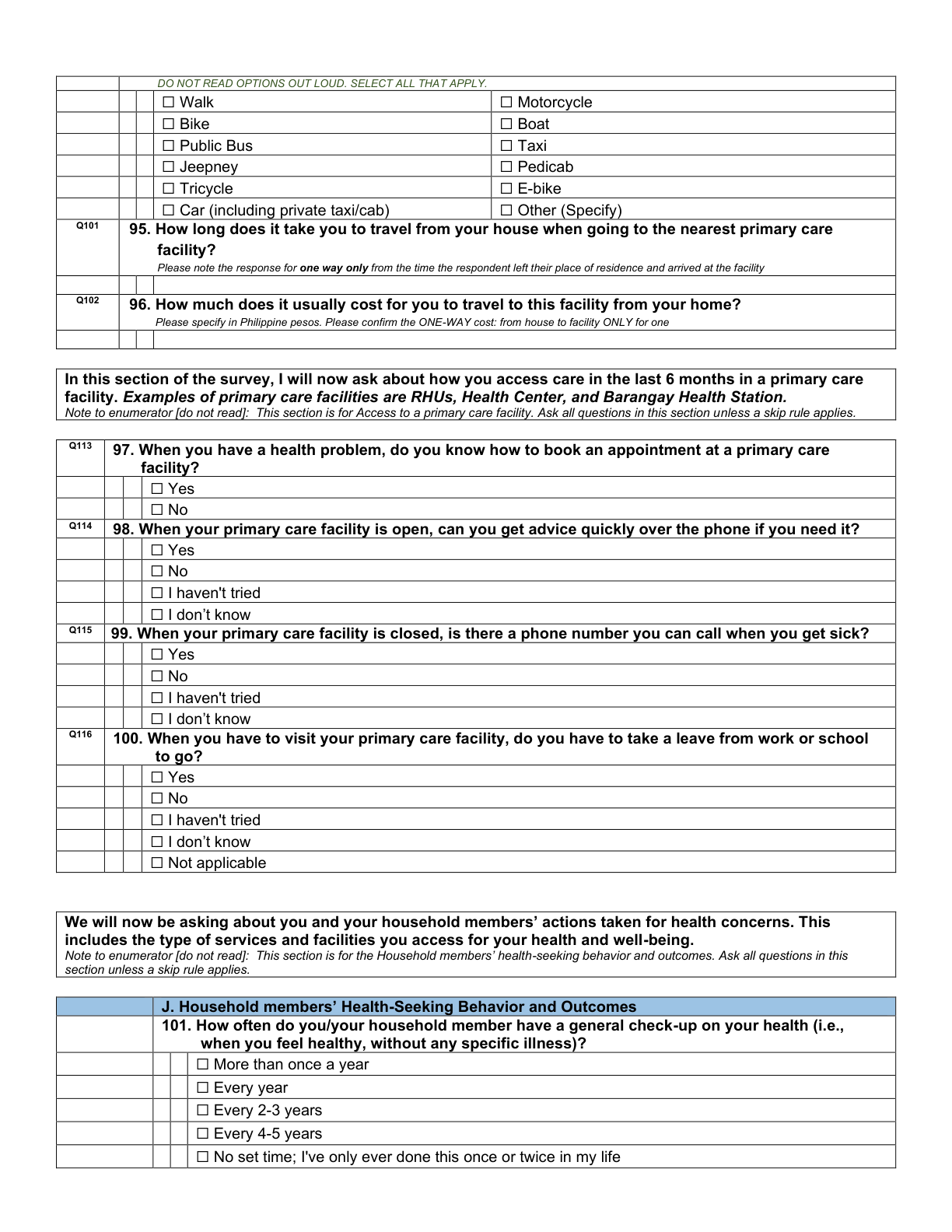
Page 14 — Household Members' Health-Seeking Behavior and Outcomes. Tap to open full size.
CSEntry (tablet)
Single-selects (Q101), Yes/No (Q104–Q105) and check-box multi-selects (Q102/Q103/Q106/Q107); Q105 = Yes is the gate that exposes Q106.
On paper
108. In the past 6 months, did a healthcare worker refer you to another facility or specialist for further care or specialized care? · 109. What type of care was the referral for? · 110. What kind of specialist did they recommend?
- Q108: Yes · No
- Q109 (check all): Outpatient care · Emergency care · Inpatient care · Dental care · Other facility visits · Special therapy visits · Alternative care · Outreach / medical missions · Home healthcare · Telemedicine · None of the above · Other (Specify)
- Q110: No specialty · Anesthesia · Dermatology · Emergency Medicine · Family Medicine · General Surgery · Internal Medicine · Neurology · Nuclear Medicine · Obstetrics and Gynecology · Occupational Medicine · Ophthalmology · Orthopedics · Otorhinolaryngology (ENT) · Pathology · Pediatrics · Physical and Rehabilitation Medicine · Psychiatry · Public health · Radiology · Research · I don't know · Other (Specify)
On the tablet (CAPI)
Q108 is a Yes/No gate. If Q108 = No, the whole referral block (Q109–Q118) is skipped. Q109 is a check-box multi-select (long specialist list at Q110 renders as a scrolling single-select); "Other (Specify)" on both opens a gated free-text box.
On paper
111. How did they refer you to the doctor? · 112. Did you visit another facility after the referral? · 113. Why are you not planning to visit?
- Q111: Physical referral slip · E-referral · Phone call from referring facility to receiving facility · I don't know · Other (Specify)
- Q112: Yes · No, I'm not planning to · Not yet, but I'm planning to
- Q113 (check all): Facility is too far · Do not trust the referred facility · No time · Worried about additional costs · Not needed · Don't know how to get to facility · Other (Specify)
On the tablet (CAPI)
Q111 and Q112 are single-selects. Q113 (a check-box multi-select) only appears when Q112 = "No, I'm not planning to" — those who visited or plan to visit skip it. "Other (Specify)" opens a gated text field.
On paper
114. Did they discuss with you the different places you could have gone to get help with your problem? · 115. Did they help you make the appointment for that visit? · 116. Did they write down any information for the specialist about the reason for that visit? · 117. After you went to the specialist or special service, did they follow up with you about what happened at the visit? · 118. Overall, how would you rate your satisfaction with the referral process?
- Q114 / Q115 / Q116: Yes · No
- Q117: Yes · No (only if Q112 = Yes)
- Q118: Very Satisfied · Satisfied · Neither Satisfied nor Dissatisfied · Dissatisfied · Very Dissatisfied · Not applicable
On the tablet (CAPI)
Q114–Q116 are Yes/No. Q117 and Q118 only show when Q112 = Yes (the respondent actually visited). Q118 is a 5-point rating scale with a "Not applicable" option.
On paper
119. Was the visit to the facility a referral from your primary care facility? · 120. Does your primary care provider know that you made the visit? · 121. As it was not a referral, why did you decide to visit a hospital?
- Q119: Yes · No
- Q120: Yes · No · I don't know
- Q121 (check all): Referred by other specialist (doctor in another hospital) · Nearest facility to house · Facility is usual source of care · Facility is the only place that can perform a certain test · Referred by BHW/nurse/midwife/other community health professional · Referred by family / friends · Facility offers subsidized or free health services · I don't know · Other (Specify)
On the tablet (CAPI)
Q119 is Yes/No, Q120 is Yes/No/Don't-know. Q121 (a check-box multi-select) is the "why not a referral" branch for hospital visits that did not come from the primary care facility; "Other (Specify)" opens a gated text field.
On paper
122. Did your primary care provider discuss with you different places you could have gone to get help with your problem? · 123. Did your primary care provider (PCP) or someone working with your PCP help you make the appointment for that visit? · 124. Did your primary care provider write down any information for the specialist about the reason for that visit? · 125. Overall, how would you rate your experience with the referral process?
- Q122 / Q123 / Q124: Yes · No
- Q125: Very Satisfied · Satisfied · Neither Satisfied nor Dissatisfied · Dissatisfied · Very Dissatisfied · Not applicable
On the tablet (CAPI)
Q122–Q124 are Yes/No coordination items. These sit on the non-referral branch (after Q119 = No), mirroring Q114–Q116. Q125 is the 5-point rating scale that closes the section.
The real printed pages
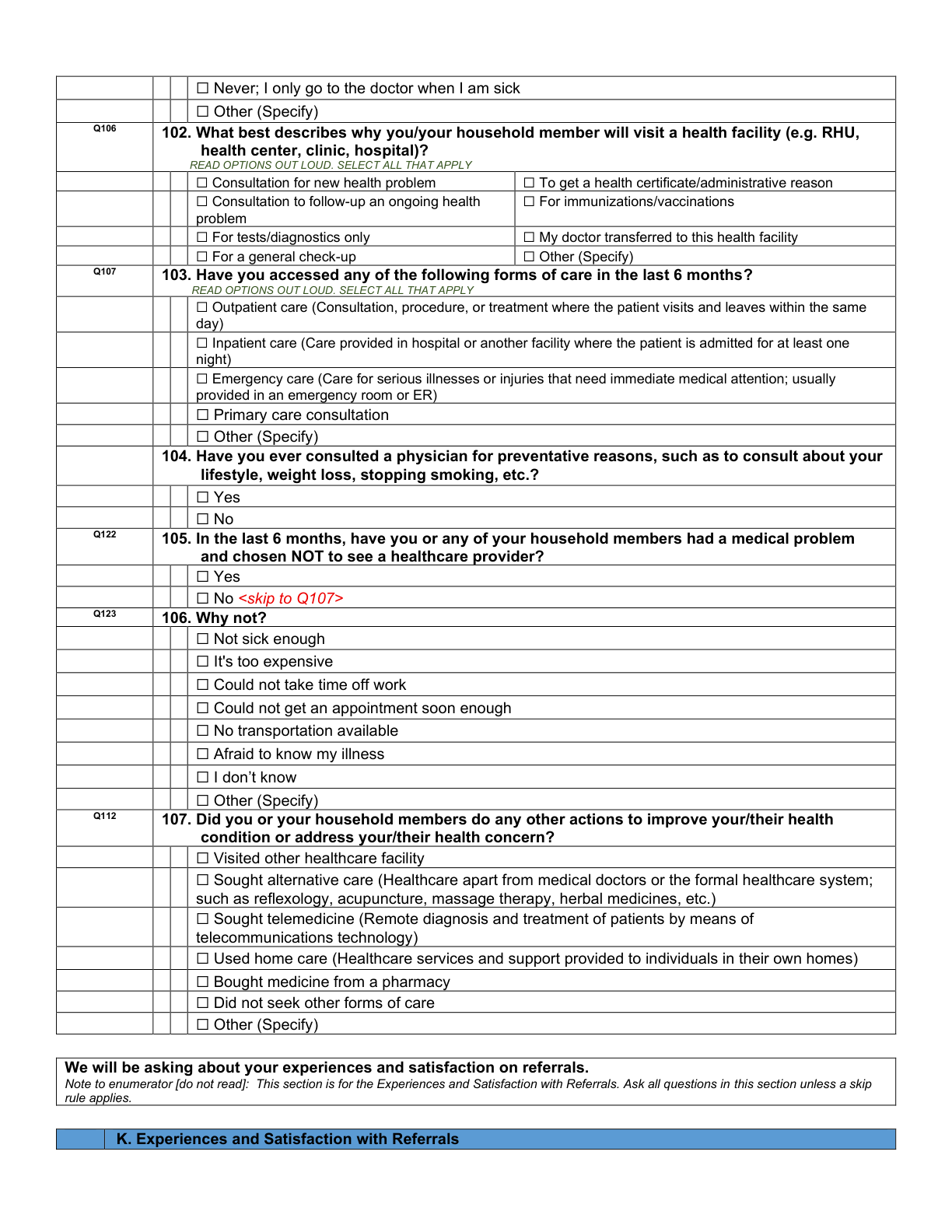
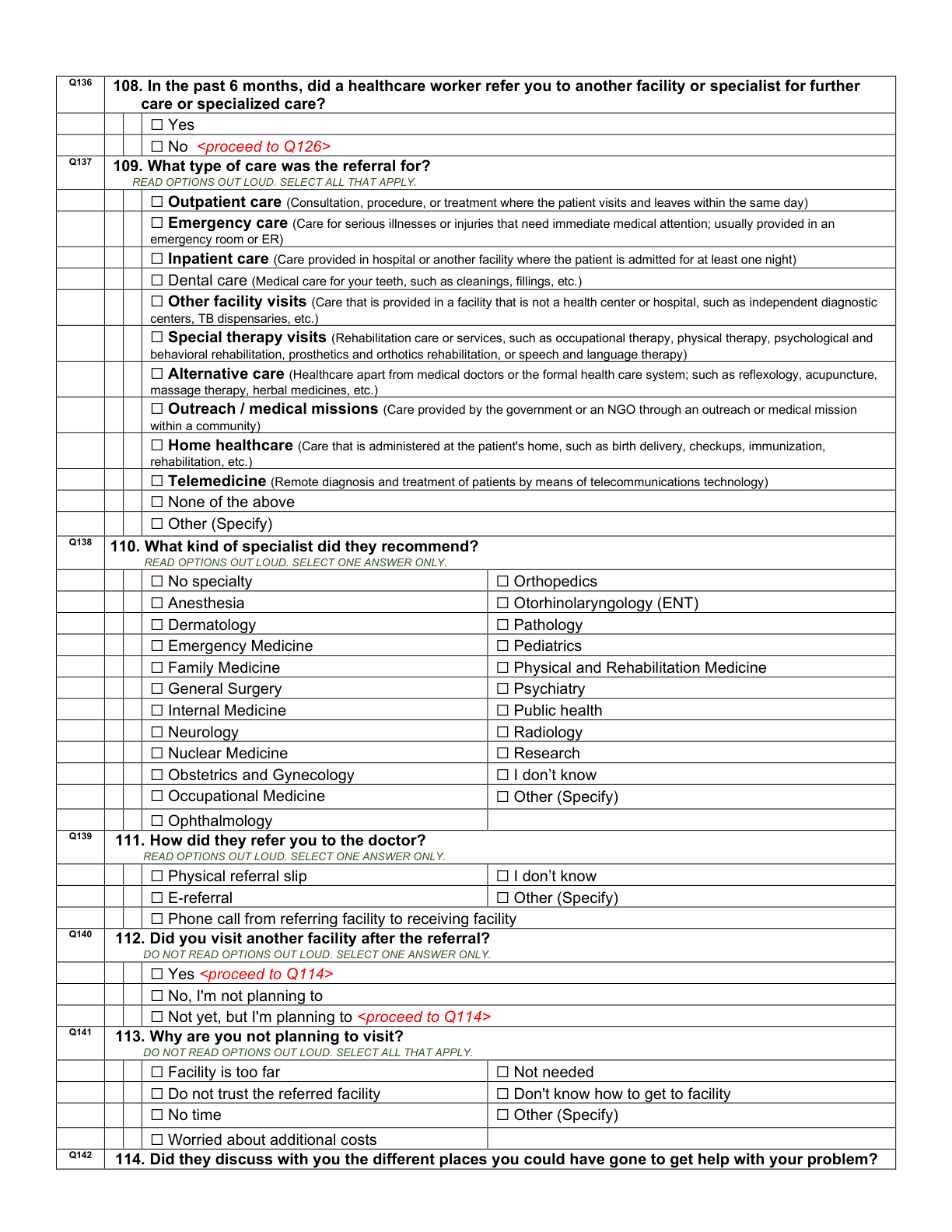
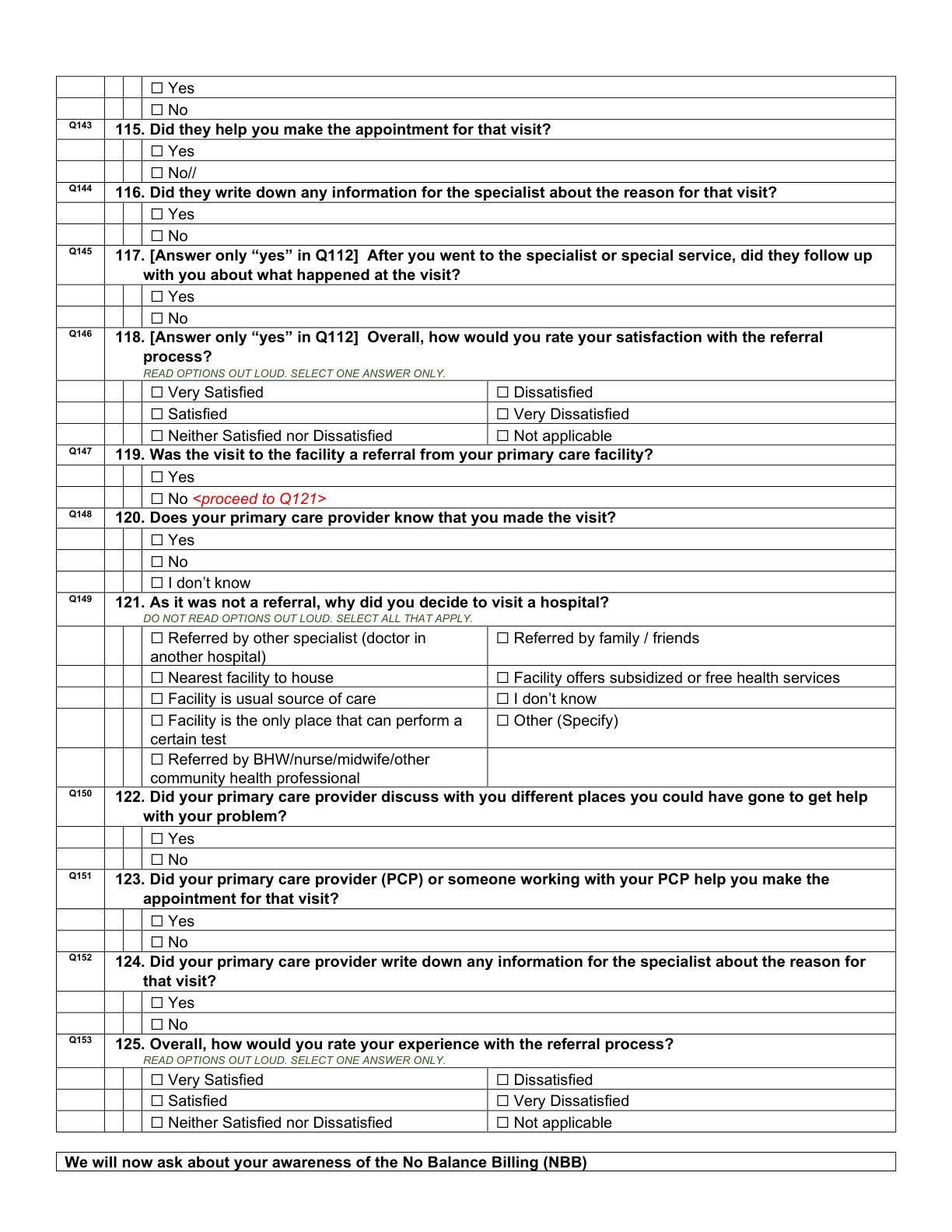
Pages 15–17 — Experiences & Satisfaction with Referrals. Tap to open full size.
CSEntry (tablet)
Yes/No gates, single-selects, check-box multi-selects, and two 5-point satisfaction scales, with Q112/Q119 driving the referral vs non-referral branches.
On paper
126. Have you heard of the No Balance Billing (NBB)? · 127. If yes, what are your sources of information about NBB?
- Q126: Yes · No · I don't know
- Q127 (check all): News · Legislation · Social Media · Friends / Family · Health center/facility · LGU/Barangay · I don't know · Other (Specify)
On the tablet (CAPI)
Q126 is a Yes/No/Don't-know gate. If Q126 = No or I don't know, the tablet skips straight to Section M (Q132), bypassing Q127–Q131. Q127 is a check-box multi-select with a gated "Other (Specify)" text field.
On paper
128. What is your understanding about NBB?
- Q128 (check all): Patient does not pay any hospital bill · Bills are settled between the hospital and PhilHealth · PhilHealth will cover cost of treatment · Patients should not be charged extra fees · Medicine and service are already included · No cash payment required upon discharge · Applies only to certain patients or hospitals · I don't know · Other (Specify)
On the tablet (CAPI)
Q128 is a check-box multi-select; the interviewer ticks every understanding the respondent gives. It only appears when Q126 indicates awareness; "Other (Specify)" opens a gated free-text box.
On paper
129. Were you or any of your household members confined in a hospital during the past 6 months? · 130. For the most recent hospitalization, what type of hospital? · 131. During your hospitalization in a DOH-retained hospital, did you or your family pay anything out-of-pocket before being discharged that should have been covered under NBB?
- Q129: Yes · No · I don't know
- Q130: Public · DOH-retained hospital (sub-type of public hospital) · Private
- Q131: Yes · No · I don't know
On the tablet (CAPI)
Q129 is a Yes/No/Don't-know gate — if Q129 = No or I don't know, the tablet jumps to Section M (Q132). Q130 is a 3-way single-select; Q131 only fires when Q130 = DOH-retained hospital (Public or Private bypass it).
The real printed pages
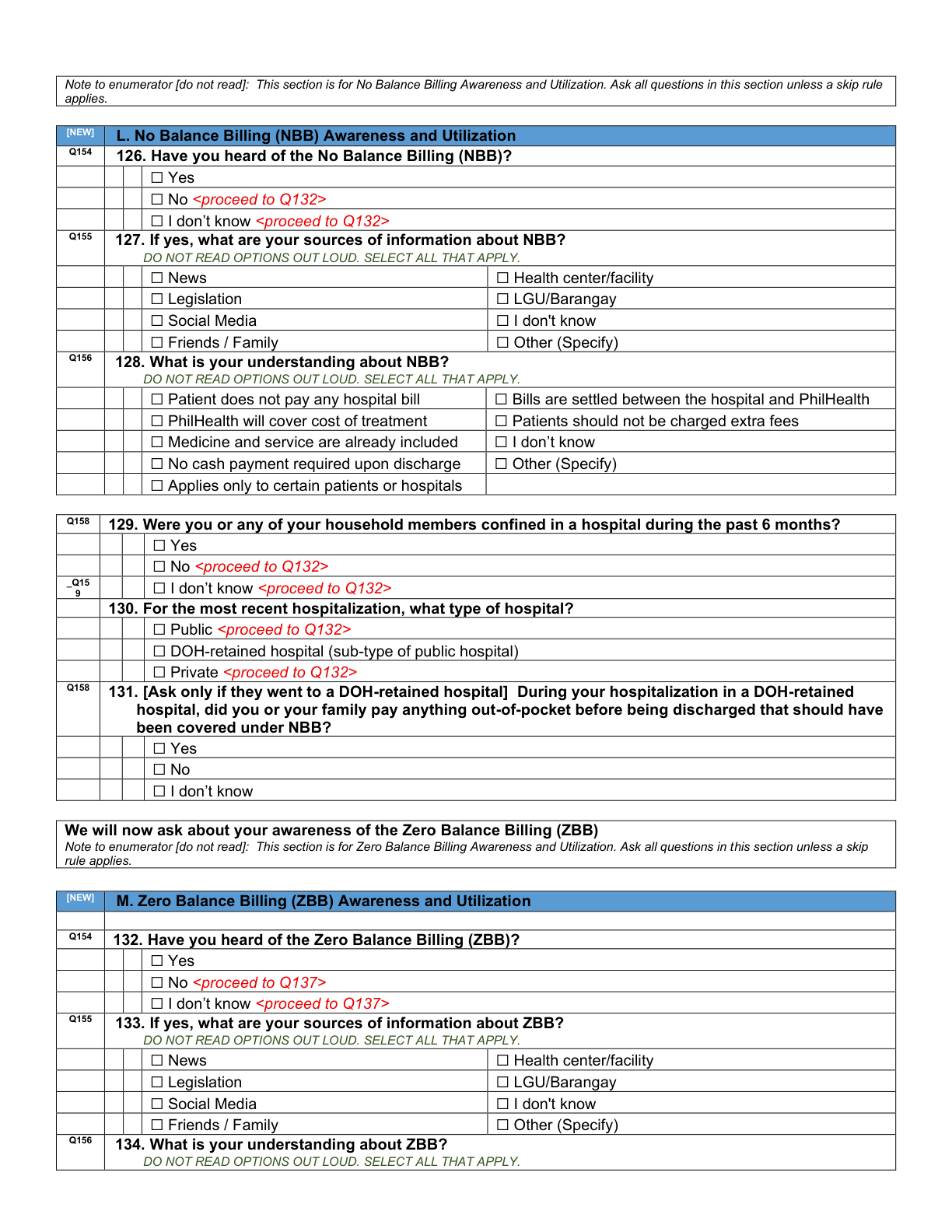
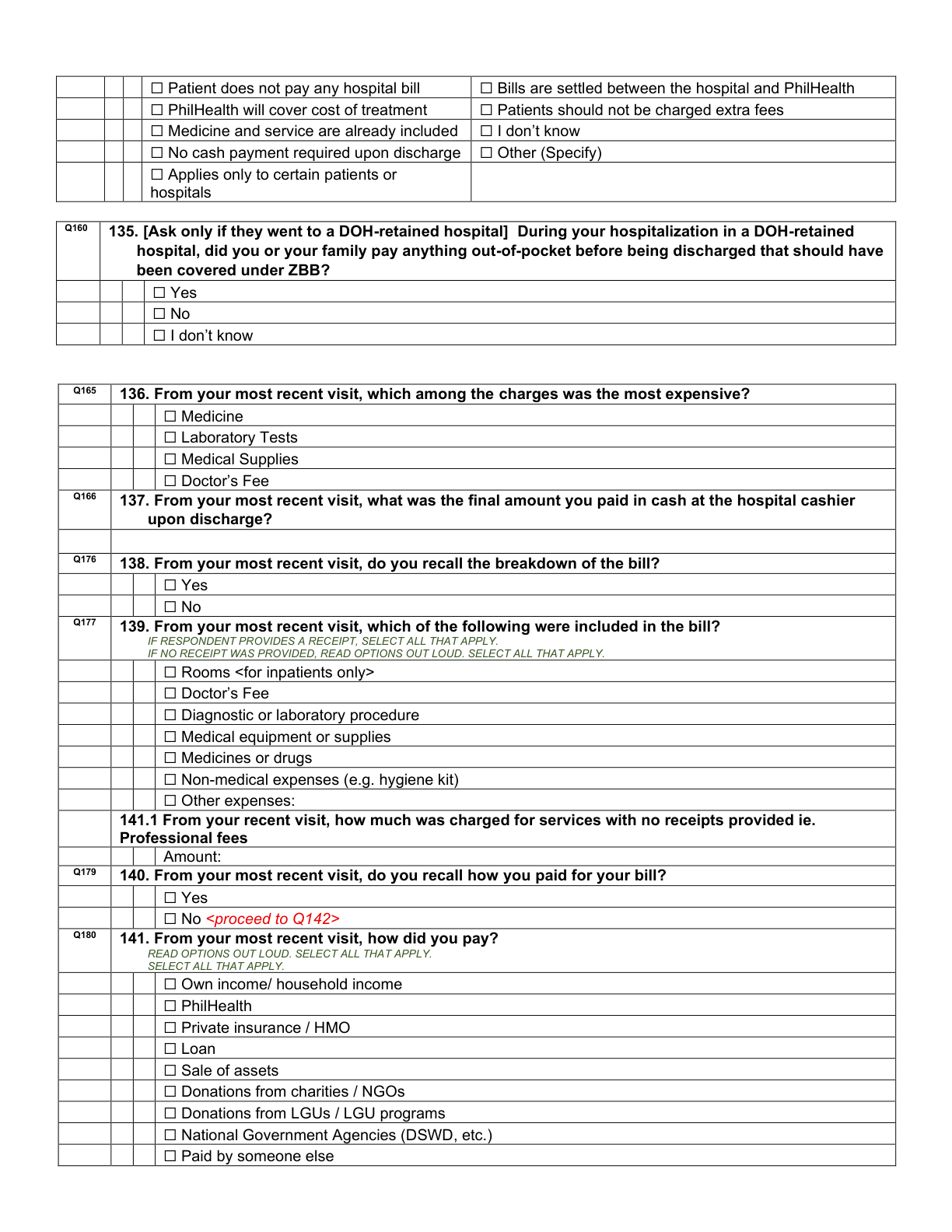
Pages 18–19 — No Balance Billing (NBB) Awareness and Utilization. Tap to open full size.
CSEntry (tablet)
Yes/No/Don't-know awareness gate, check-box source and understanding lists, and a DOH-retained-only out-of-pocket follow-up.
On paper
132. Have you heard of the Zero Balance Billing (ZBB)? · 133. If yes, what are your sources of information about ZBB? · 134. What is your understanding about ZBB?
- Q132: Yes · No · I don't know
- Q133 (check all): News · Legislation · Social Media · Friends / Family · Health center/facility · LGU/Barangay · I don't know · Other (Specify)
- Q134 (check all): Patient does not pay any hospital bill · Bills are settled between the hospital and PhilHealth · PhilHealth will cover cost of treatment · Patients should not be charged extra fees · Medicine and service are already included · No cash payment required upon discharge · Applies only to certain patients or hospitals · I don't know · Other (Specify)
On the tablet (CAPI)
Q132 is a Yes/No/Don't-know gate. If Q132 = No or I don't know, the tablet bypasses Q133–Q135 and jumps to Q136 (MAIFIP). Q133 and Q134 are check-box multi-selects, each with a gated "Other (Specify)" text field.
On paper
135. During your hospitalization in a DOH-retained hospital, did you or your family pay anything out-of-pocket before being discharged that should have been covered under ZBB? · 136. Have you heard of the Medical Assistance for Indigent and Financially Incapacitated Patients (MAIFIP)? · 137. What are your sources of information about MAIFIP?
- Q135: Yes · No · I don't know
- Q136: Yes · No · I don't know
- Q137 (check all): News · Legislation · Social Media · Friends / Family · Health center/facility · LGU/Barangay · I don't know · Other (Specify)
On the tablet (CAPI)
Q135 is the ZBB out-of-pocket follow-up. Q136 is a Yes/No/Don't-know MAIFIP gate — if Q136 = No or I don't know, the tablet skips Q137 and goes to Q138. Q137 is a check-box multi-select with a gated "Other (Specify)" field.
On paper
138. From your most recent visit, which among the charges was the most expensive? · 139. From your most recent visit, what was the final amount you paid in cash at the hospital cashier upon discharge? (PHP) · 140. From your most recent visit, do you recall the breakdown of the bill?
- Q138: Medicine · Laboratory Tests · Medical Supplies · Doctor's Fee · Other (Specify)
- Q139: ______ PHP (numeric, up to 8 digits)
- Q140: Yes · No
On the tablet (CAPI)
Q138 is a single-select; "Other (Specify)" (code 9) opens a gated text box. Q139 is a number-pad PHP amount. Q140 is a Yes/No gate for whether the bill breakdown is recalled, feeding the Q141 line-item list.
On paper
141. From your most recent visit, which of the following were included in the bill? · 141.1. From your recent visit, how much was charged for services with no receipts provided (i.e. Professional fees)? (PHP) · 142. From your most recent visit, do you recall how you paid for your bill? · 143. From your most recent visit, how did you pay?
- Q141 (check all): Rooms <for inpatients only> · Doctor's Fee · Diagnostic or laboratory procedure · Medical equipment or supplies · Medicines or drugs · Non-medical expenses (e.g. hygiene kit) · Other expenses
- Q141.1: ______ PHP (numeric, up to 8 digits)
- Q142: Yes · No
- Q143 (check all): Own income/ household income · PhilHealth · Private insurance / HMO · Loan · Sale of assets · Donations from charities / NGOs · Donations from LGUs / LGU programs · National Government Agencies (DSWD, etc.) · Paid by someone else · Other (Specify)
On the tablet (CAPI)
Q141 and Q143 are check-box multi-selects (Q141 "Other expenses" has its own free-text; Q143 "Other (Specify)" is gated). Q141.1 is a number-pad PHP amount. Q142 is a Yes/No gate — if Q142 = No, the tablet skips Q143 (how-paid) and moves to the next section.
The real printed pages
Pages 18–19 — Zero Balance Billing (ZBB) Awareness, MAIFIP, and Bill Breakdown. Tap to open full size.
CSEntry (tablet)
Awareness gates (ZBB, MAIFIP), check-box source/understanding/bill-item lists, PHP number-pad amounts, and Yes/No recall gates driving the bill-breakdown branches.
On paper
144. Cereals (rice, flour, noodles, corn, etc.) · 148. Fish and other seafoods · 149. Any kind of meat and offal · 155. Water and non-alcoholic beverages · 156. Alcoholic beverages · 157. Sub-total (food, last week) [DO NOT ASK] · 158. Meals, snacks and beverages from restaurants (dine-in, take-out, deliveries)
- Per item: Consumed? Yes / No · Amount purchased (PHP) · Estimated value in-kind (PHP)
- Q157: auto-computed sub-total (PHP) — interviewer does not ask
On the tablet (CAPI)
An expenditure grid — one Amount-in-Pesos number-pad per item; the form walks the food item list (Q144–Q156, last-week recall), capturing for each a Consumed Yes/No gate then purchased and in-kind peso amounts. Q157 sub-total is auto-computed (DO NOT ASK) and Q158 restaurant meals follows on the same recall.
On paper
159. Smoking and smokeless tobacco products (last week) · 162. Utilities — electricity, water, refuse/sewage, fuels (last month) · 163. Passenger transportation incl. personal-vehicle fuel (last month) · 167. Housing (actual rentals, estimated rent if owned) · 169. Ready-made clothing and footwear (last 6 months) · 170. Educational services (last 12 months) · 173. Health insurance · 174. Other insurance (life, accident, travel)
- Per item: Consumed? Yes / No · Amount purchased (PHP) · Estimated value in-kind (PHP)
- Recall period varies by block: Q159 last week · Q160–Q167 last month · Q168–Q169 last 6 months · Q170–Q174 last 12 months
On the tablet (CAPI)
An expenditure grid — one Amount-in-Pesos number-pad per item; the form walks the non-food list across four recall windows (week → month → 6-month → year), capturing a Consumed gate plus purchased and in-kind peso amounts for each. The reference period is fixed per block by the form, so the interviewer cannot mismatch a recall window.
On paper
175. Inpatient care services · 176. Emergency transportation and rescue services · 177. Total of 175 & 176 (health, 12-month) [DO NOT ASK] · 178. Preventive services (immunization/vaccination, excl. cost of vaccine) · 179. Diagnostic and laboratory tests · 180. Assistive products (vision, hearing, mobility) · 181. Medical products (antigen tests, glucose meters, masks) · 182. Total of 178–181 (health, 6-month) [DO NOT ASK]
- Per item: Consumed? Yes / No · Amount purchased (PHP) · Estimated value in-kind (PHP)
- Q177, Q182: auto-computed sub-totals (PHP) — not asked
On the tablet (CAPI)
An expenditure grid — one Amount-in-Pesos number-pad per item; the form walks the 12-month health items (Q175–Q176) then the 6-month items (Q178–Q181), capturing a Consumed gate plus peso amounts. Q177 and Q182 sub-totals are auto-computed (DO NOT ASK) and inserted by the form, not keyed by the interviewer.
On paper
183. Medicines (branded, generic, herbal), vaccines, oral contraceptives, and other pharmaceutical preparations, incl. online · 184. Outpatient medical and dental services, incl. online, without overnight stay · 185. Total of 183 & 184 (health, 1-month) [DO NOT ASK]
- Per item: Consumed? Yes / No · Amount purchased (PHP) · Estimated value in-kind (PHP)
- Q185: auto-computed sub-total (PHP) — not asked
On the tablet (CAPI)
An expenditure grid — one Amount-in-Pesos number-pad per item; the form captures the last-month health items (Q183 medicines, Q184 outpatient) with a Consumed gate plus peso amounts. Q185 sub-total is auto-computed (DO NOT ASK), closing the SHA expenditure module.
The real printed pages
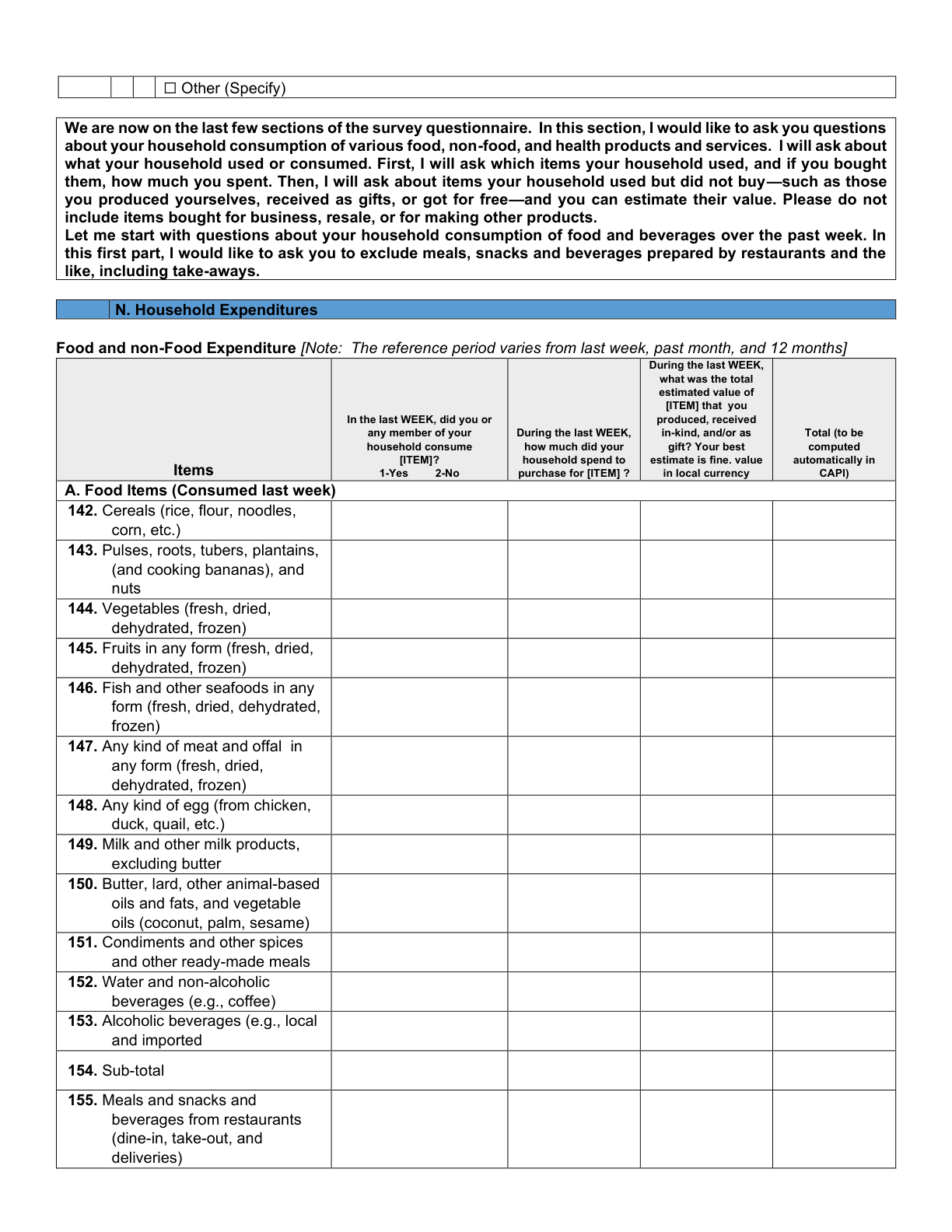
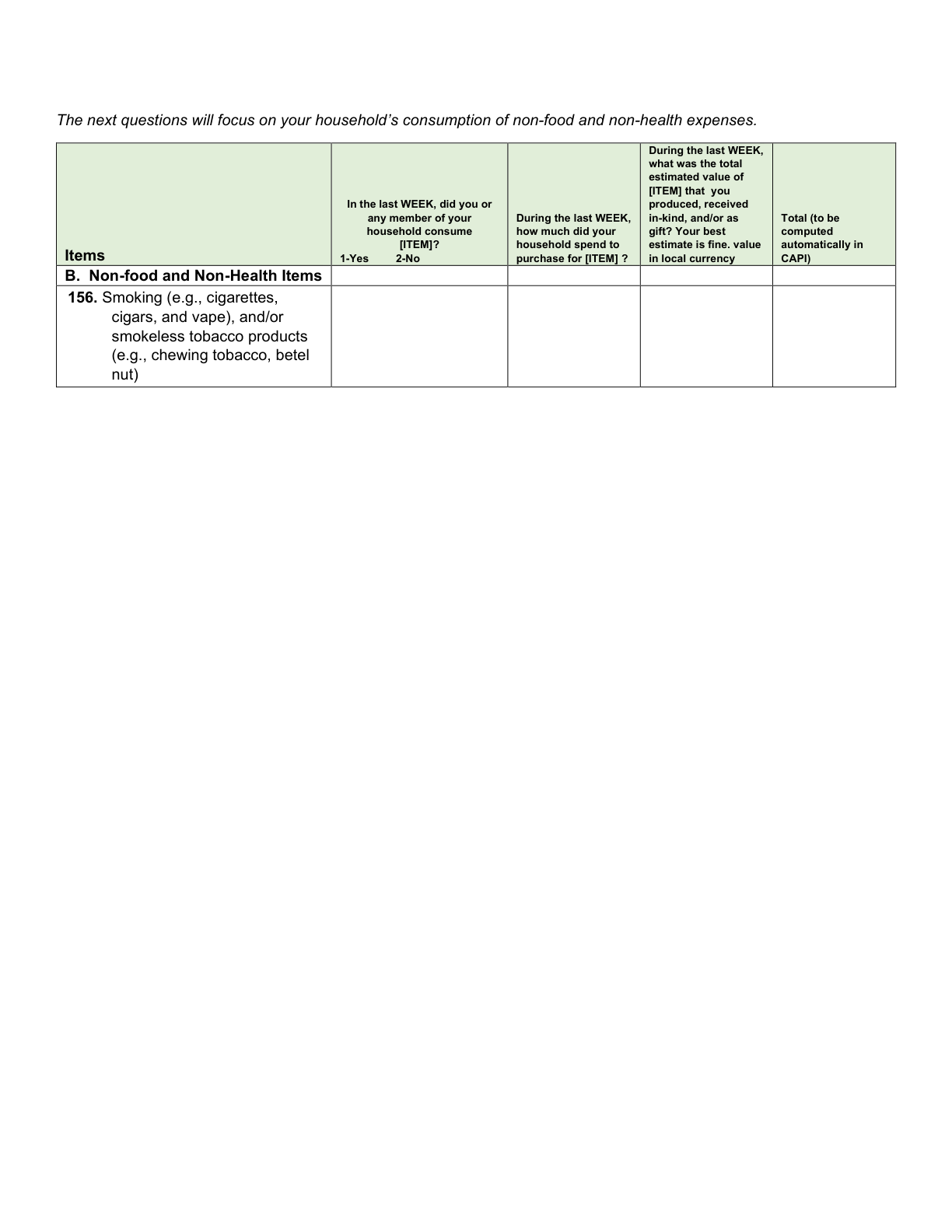
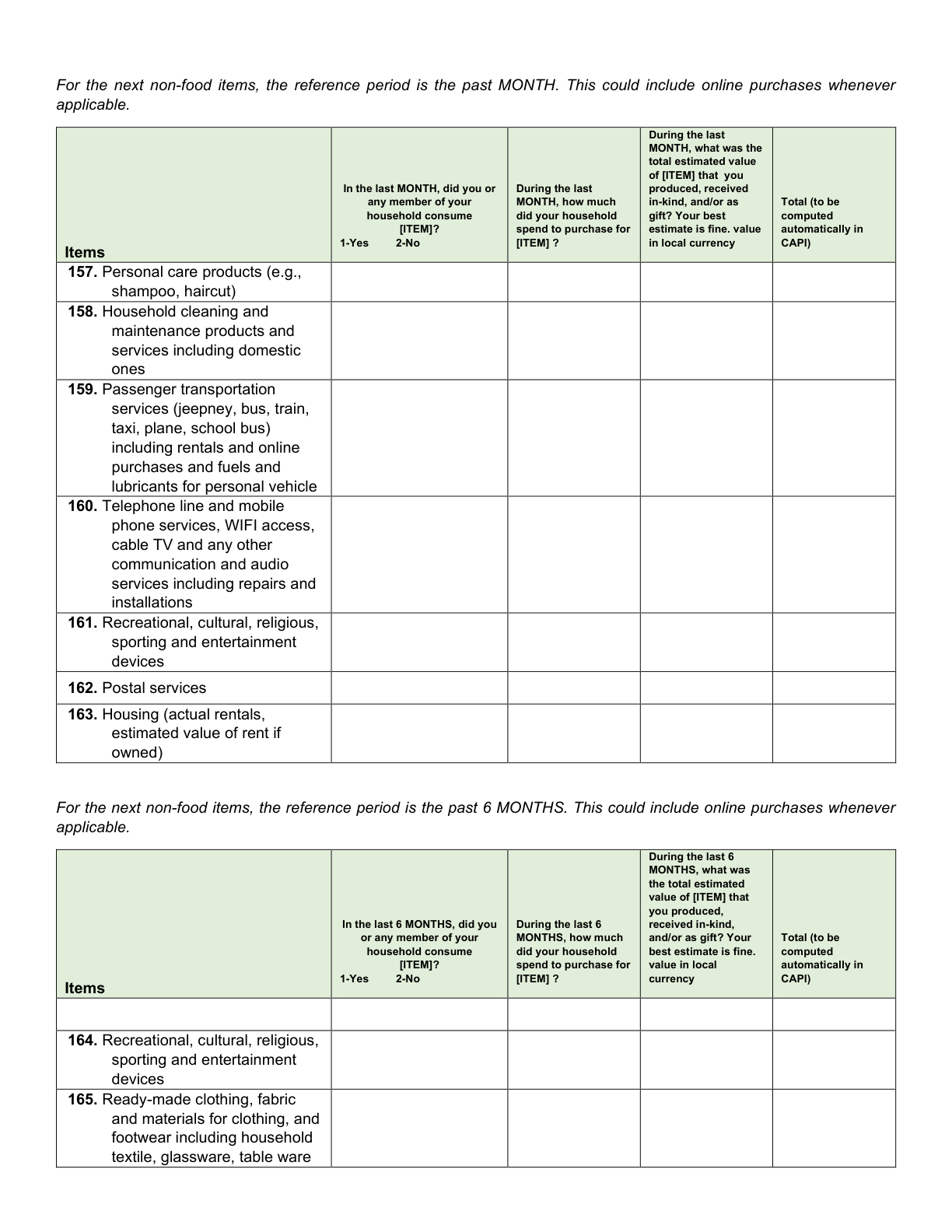
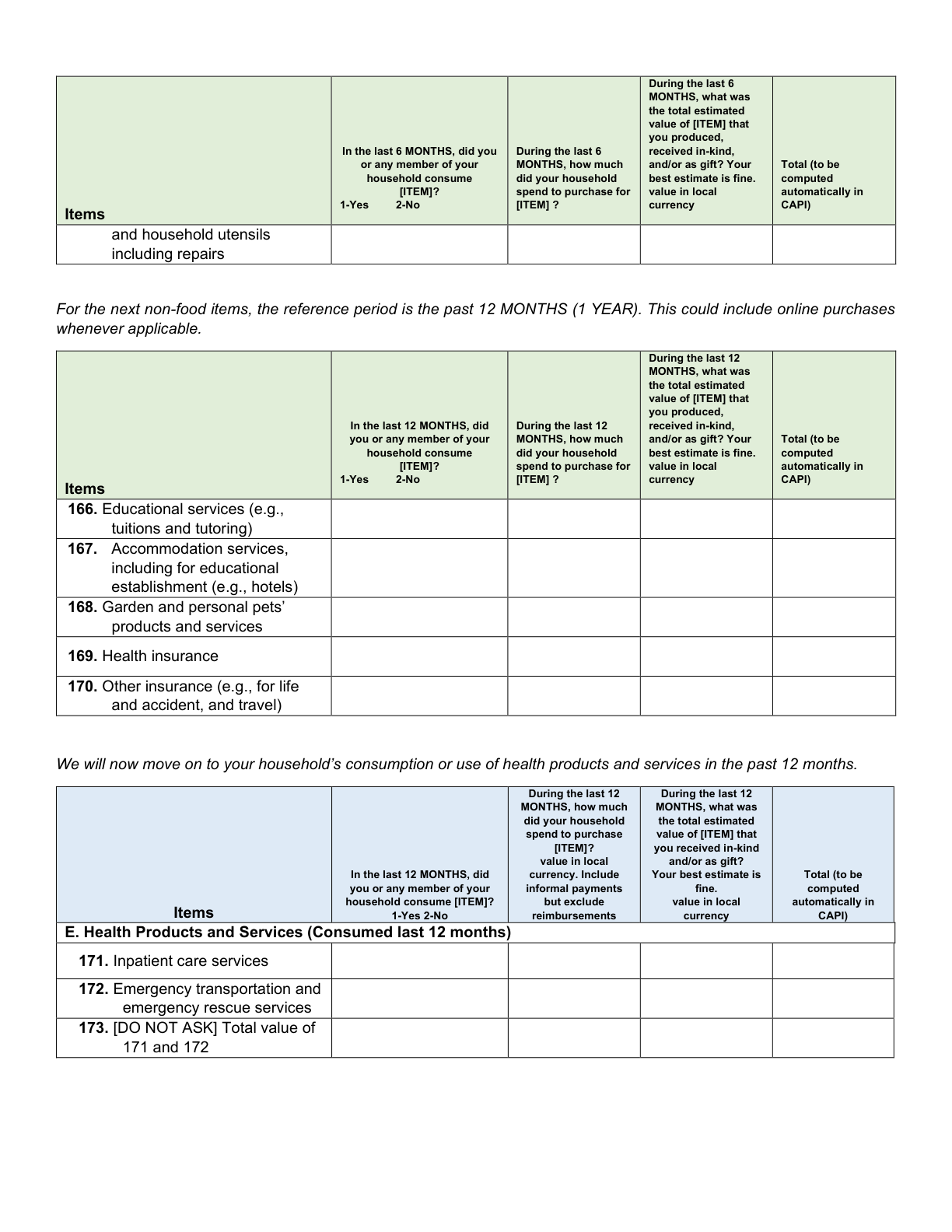
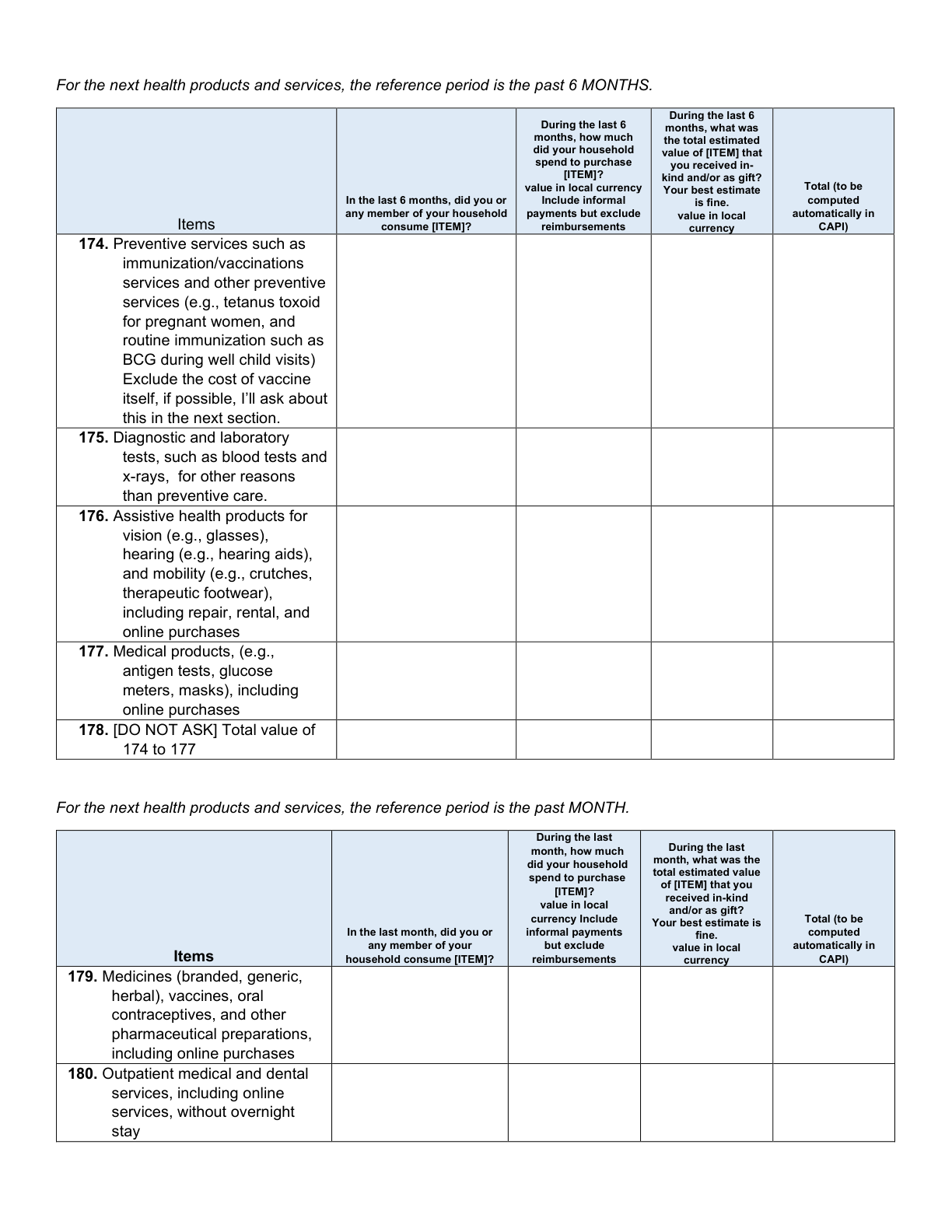
Pages 20–24 — Household Expenditures. Tap to open full size.
CSEntry (tablet)
Number-pad control — one peso amount per line item, walked across the food / non-food / health-product lists with running validation.
On paper
186. Current income of any household members · 187. Savings, pension · 188. Selling of household assets or goods (housing, land, animals, jewelry, appliances, machines) · 189. Borrowing from friends or relatives outside the household · 190. Borrowing from institutions · 191. Remittance or money gift · 192. Government assistance (DSWD, local, etc.) · 193. Donation from LGUs · 194. Other (specify)
- Each Q186–Q194: Yes · No
- Q194 Other: free-text box if Yes
On the tablet (CAPI)
A Yes/No tap per funding source (Q186–Q194). Q194 "Other" opens a gated free-text box only when the interviewer taps Yes.
On paper
195. What portion of your household's monthly income would you be willing to set aside for health care if it reduced unexpected medical expenses? · 196. If your household chooses not to spend on health care for financial reasons, what kind of care do you usually forego?
- Q195: None · Less than 1% · 1-3% · 4-6% · More than 6% · Don't know
- Q196 (tick all): Doctor/consultation visit · Medicines or treatments · Laboratory tests / diagnostics · Hospital admission / inpatient care · Preventive care · Dental care · Other (please specify) · We do not forego care
On the tablet (CAPI)
Q195 is a single-select list (six income-portion bands). Q196 is a tick-all check-box (#638, converted from per-option Yes/No); "Other (please specify)" maps to code 99 and opens a gated text box, and "We do not forego care" is an ordinary option (no exclusivity enforced). Skip logic: any Q195 answer except "None" jumps past Q196 to Q197; only Q195 = "None" falls through to Q196.
The real printed pages
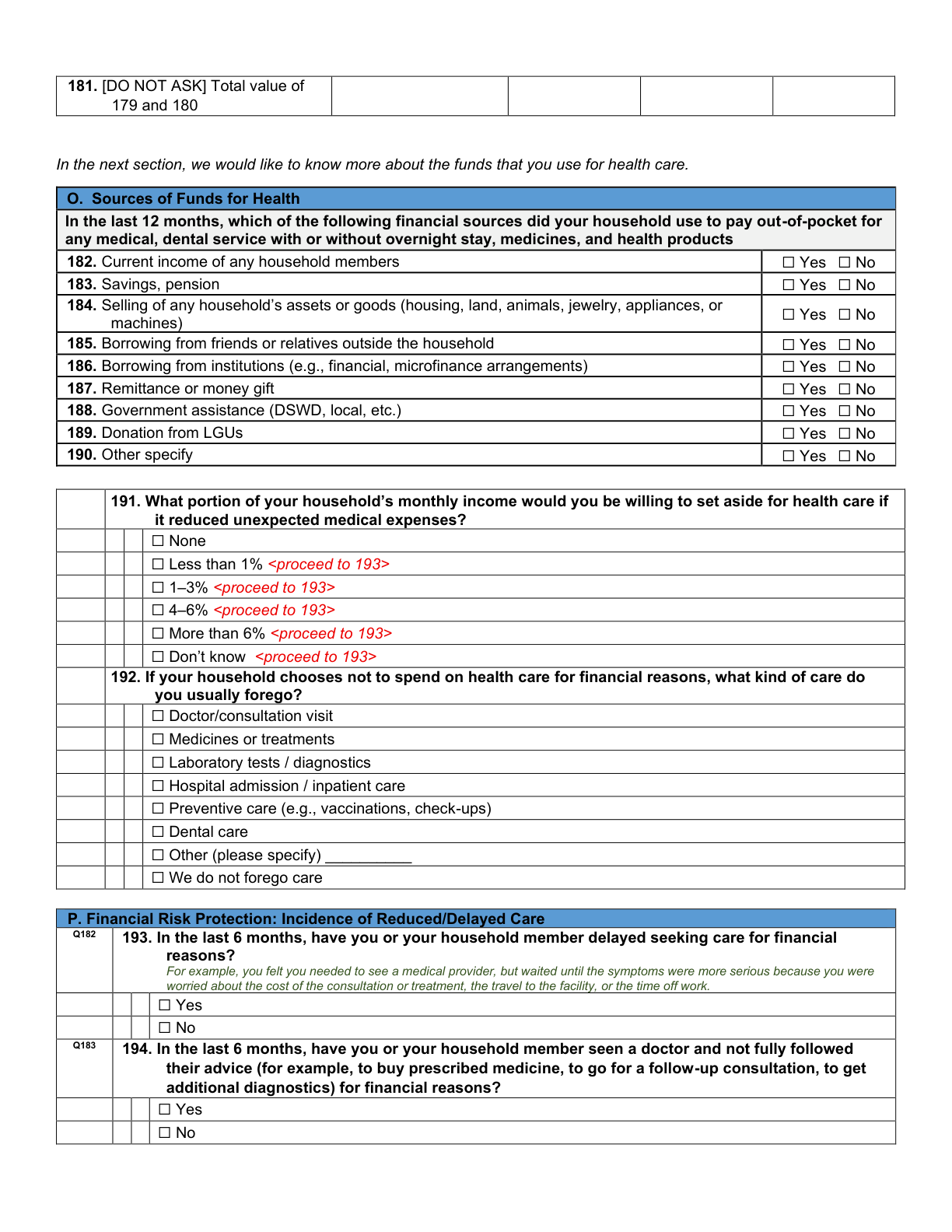
Page 25 — Sources of Funds for Health. Tap to open full size.
CSEntry (tablet)
Yes/No funding battery (Q186–Q194), a single-select band for Q195, and a tick-all check-box for Q196.
On paper
197. In the last 6 months, have you or your household member delayed seeking care for financial reasons? · 198. In the last 6 months, have you or your household member seen a doctor and not fully followed their advice (e.g., to buy prescribed medicine, go for follow-up, get additional diagnostics) for financial reasons?
- Q197: Yes · No
- Q198: Yes · No
On the tablet (CAPI)
A Yes/No tap for each (Q197 delayed care, Q198 advice not followed). Both are always asked — no skip gate between them.
On paper
199. The usual price for a consultation ranges from Php 500 to Php 2,000. What is the highest amount you are willing to pay for a consultation?
- Php 0 – Php 249 · Php 250 – Php 499 · Php 500 – Php 999 · Php 1,000 – Php 1249 · Php 1,250 – Php 1499 · Php 1,500 – Php 1749 · Php 1,750 – Php 1999 · Php 2,000 and above · Other (Specify)
On the tablet (CAPI)
A single-select list of nine price bands. Selecting "Other (Specify)" opens a gated free-text box for the amount; the rest of the bands skip straight past it.
The real printed pages
Page 25 — Financial Risk Protection. Tap to open full size.
CSEntry (tablet)
Two Yes/No taps (Q197–Q198) and a single-select willingness-to-pay band list (Q199) with a gated Other box.
On paper
200. Have you or your household had to reduce spending on things you need (such as food, housing, or utilities) because of this health expenditure in the last 1 month? · 201. How worried are you about your household's finances in the next 1 month?
- Q200: Yes · No · Don't know · Refused to answer
- Q201: Very worried · Somewhat worried · Not too worried · Not worried at all
On the tablet (CAPI)
Each is a single-select rating scale. Skip logic: Q200 "Refused to answer" ends the survey; Q201 "Not worried at all" ends the survey, bypassing Q202.
On paper
202. Do any of the following reasons describe why you are worried about your household's finances in the next 1 month?
- Loss of income · Healthcare costs related to coronavirus (COVID-19) · Healthcare costs NOT related to coronavirus (COVID-19) · Other (Specify)
On the tablet (CAPI)
A tick-all check-box (#668, converted from select_all); "Other (Specify)" maps to code 99 (#686) and opens a gated text box. Q202 is only reached when Q201 is more worried than "Not worried at all" — otherwise the survey has already ended.
The real printed pages
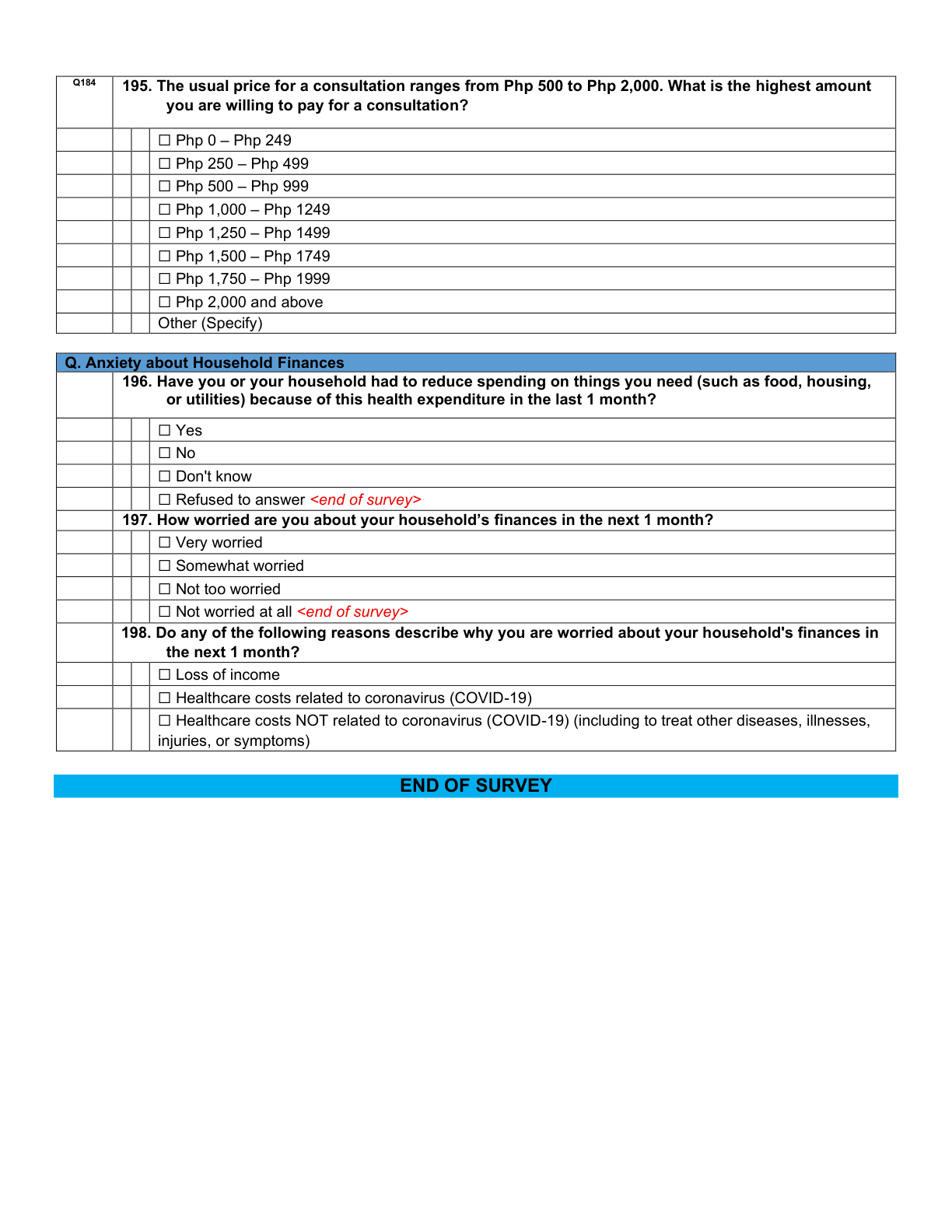
Page 26 — Anxiety about Household Finances. Tap to open full size.
CSEntry (tablet)
Two single-select rating scales (Q200–Q201) with survey-ending skips, and a tick-all check-box for reasons (Q202).